

LUMEN X™ | CELLINK
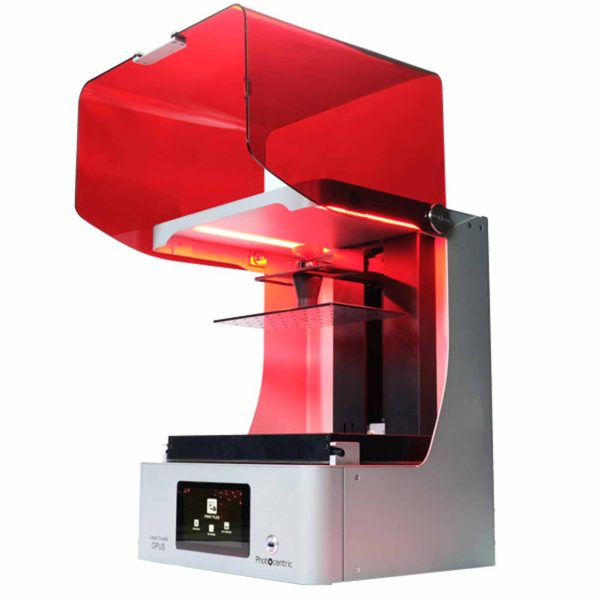
The CELLINK LUMEN X Gen 3 is a benchtop digital light processing bioprinter for rapid fabrication of photo-crosslinkable structures. A 405 nm projection system exposes an entire image plane at once, allowing each layer to be cured without tracing every feature with a nozzle.
The platform combines 35 µm XY pixel resolution, a build volume of 68 × 38 × 100 mm, grayscale printing and temperature control from room temperature to 60 °C. These capabilities support the production of scaffolds, microfluidic structures, tissue-engineering constructs and material gradients from compatible photoinks.
Resources:
Key benefits
- Layer-by-layer DLP: Projects each layer as an image for rapid fabrication of photo-crosslinkable geometries.
- 35 µm XY pixels: Supports detailed structures and complex internal features within the limits of the material and exposure process.
- 405 nm visible light: Designed for compatible photoinks and live-cell workflows.
- Grayscale printing: Varying exposure can be used to create spatial differences in curing and biomechanical properties.
- Temperature control: The build region can be controlled from room temperature to 60 °C.
- Modular build platforms: Glass-bottom and metal platforms are available in several sizes for different applications.
- Sterility-oriented workflow: UV-C chamber sterilisation, autoclavable build platforms and sterile photoink vats support controlled preparation.
- DNA Studio Illuminate: Prepare models, control print settings and manage light-based fabrication workflows.
How DLP bioprinting works
The model is divided into image layers. For each layer, the DLP system projects a patterned 405 nm image into a compatible photoink, initiating crosslinking in the exposed regions. The platform then advances in Z and repeats the process until the construct is complete.
Feature quality depends on pixel size, optical focus, light dose, photoinitiator, photoink absorption, layer thickness, curing kinetics and post-exposure behaviour. The 35 µm pixel specification should therefore be treated as an optical sampling parameter rather than a universal guaranteed feature dimension.
Applications
- Macroporous scaffolds and tissue-engineering constructs
- Microfluidic and lab-on-a-chip structures
- Vascular and perfusable model development
- Material and photoink formulation research
- Grayscale stiffness gradients
- Drug-development and screening models
- Live-cell printing with compatible formulations
- Complex hydrogel structures and regenerative-medicine research
Technical specifications
| Parameter | Manufacturer specification |
| Bioprinting technology | layer-by-layer digital light processing |
| XY pixel resolution | 35 µm |
| LED wavelength | 405 nm, FWHM 15 nm |
| Intensity range | up to 30 mW/cm² |
| Build volume | 68 × 38 × 100 mm |
| Temperature range | room temperature to 60 °C |
| Build platforms | glass-bottom and metal platforms in three sizes |
| UV sterilisation | UV-C, 265–285 nm |
| Sterility features | autoclavable build platforms and sterile photoink vats |
| Software | embedded interface and DNA Studio Illuminate |
| Display | high-resolution 10-inch glove-friendly touchscreen |
| Connectivity | USB-A, USB-C and Ethernet |
| Supported files | .stl and BMP, GIF, PNG or JPG image files |
| Instrument dimensions | 414 × 373 × 451 mm, W × D × H |
| Weight | 15.6 kg |
When should a laboratory choose LUMEN X Gen 3?
LUMEN X Gen 3 is well suited to researchers who need a flexible benchtop DLP platform, a relatively large Z build range, modular build surfaces or layer-by-layer control for scaffolds, microfluidics and photoink development.
Choose BIONOVA X when the priority is 10 µm resolution, direct printing in standard multi-well plates, high-throughput in-well workflows or layerless continuous printing. Choose BIO X or BIO X6 when the process requires extrusion rather than projected-light fabrication.
Frequently asked questions
What materials can LUMEN X Gen 3 print?
The system requires materials that can be crosslinked using its 405 nm optical process. CELLINK offers compatible photoinks, and researchers can develop custom formulations. Compatibility depends on photoinitiator, absorption, viscosity, cells and the required exposure.
Is LUMEN X Gen 3 suitable for live-cell printing?
The platform is designed with live-cell printing in mind. Cell response must still be validated for the specific photoink, photoinitiator, wavelength, light dose and thermal conditions.
How does grayscale printing help?
Grayscale images vary local exposure. With a compatible material and calibrated process, this can generate spatial differences in crosslinking and stiffness, enabling biomechanical gradients.
Request a configuration
APEL Laser can help assess photoink chemistry, feature size, build platform, exposure requirements and the choice between layer-by-layer and direct in-well DLP. Contact APEL Laser or email sales@apellaser.ro.
| Manufacturer | CELLINK |
|---|---|
| Applications / Industries | Artistic and creative industry, Biology, Material Development, Medical industry, Microfluidics, Pharmaceutical Industry, Scientific research, Tissue Engineering |
| Pixel resolution (XY) | 35 μm |
Related products