
BIO ONE 3D biodispenser | CELLINK
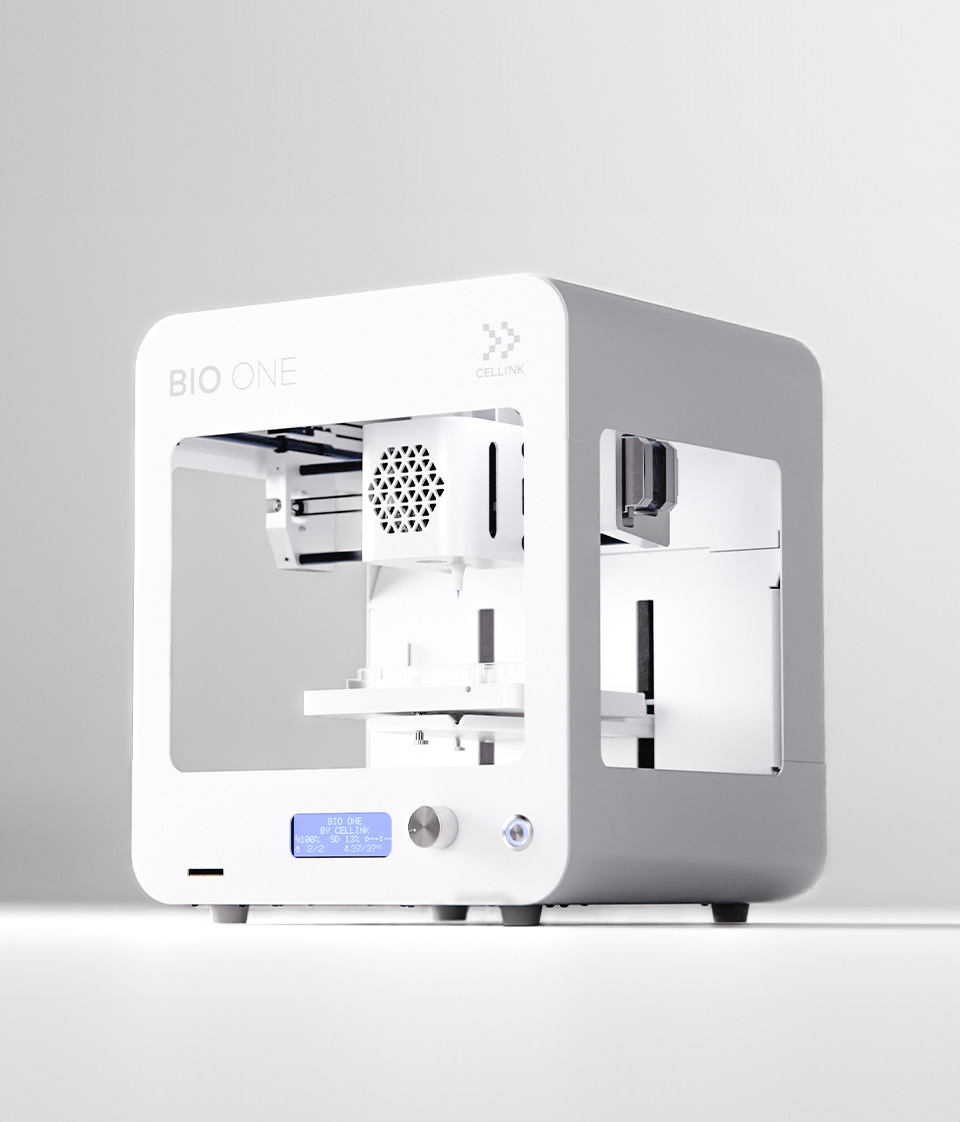
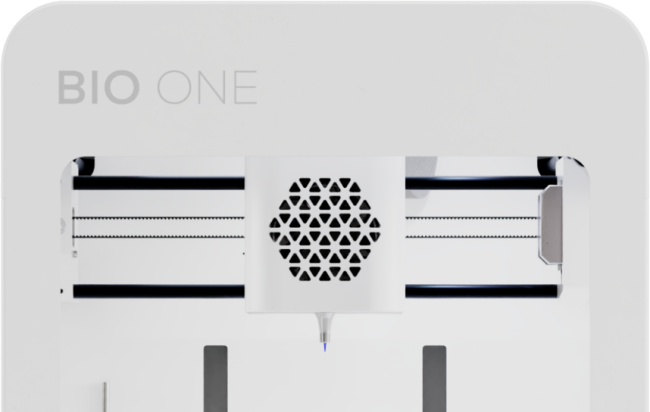
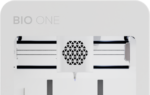
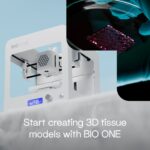
The CELLINK BIO ONE is a compact, temperature-controlled biodispensing and 3D bioprinting platform designed to help laboratories move from manual hydrogel handling and 2D culture toward reproducible 3D cell models. Its mechanically driven syringe printhead provides controlled material displacement, while active printhead cooling supports materials that require stable low-temperature handling.
Key benefits
- Cooling to 0 °C: The printhead can be cooled from room temperature to 0 °C and maintains temperature control along the material path.
- Precision mechanical extrusion: A theoretical volume unit step of 0.1 µL supports controlled dispensing and reduced material waste.
- Heated printbed: The print surface can be heated from room temperature to 65 °C for materials and workflows that benefit from thermal control.
- Open material platform: Researchers can use custom biomaterials and standard compatible syringes and nozzles rather than being restricted to a closed material ecosystem.
- Multi-well compatibility: The platform supports Petri dishes and multi-well plates from 6 to 384 wells, enabling both construct development and assay-oriented workflows.
- Reproducible protocols: DNA Studio Core enables print parameters and protocols to be configured and reused.
What can BIO ONE print?
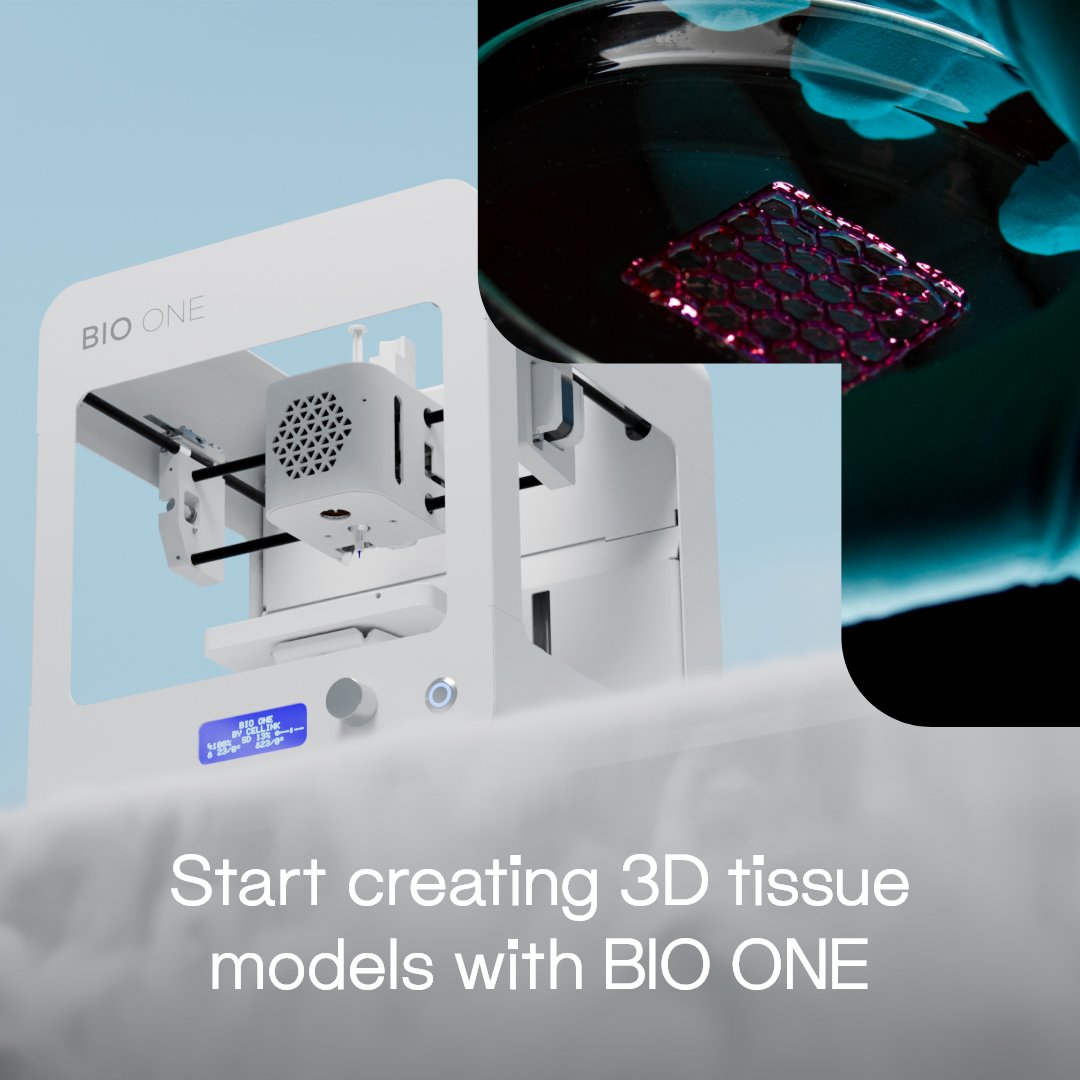
BIO ONE is well suited to droplets, droplet arrays, rings and lattices used to create spheroids, organoids and tissue constructs. The combination of a cooled printhead and heated printbed helps researchers manage materials whose viscosity or gelation behaviour is highly temperature dependent.
Typical examples include collagen-based models, Matrigel workflows, hydrogel screening, contraction assays, cartilage and skin models, smart materials and automated arrays for compound testing. Compatibility must be confirmed for the actual material formulation, cell concentration, nozzle and geometry.
Applications
- 3D cell culture and accessible transition from manual dispensing
- Tissue engineering and regenerative-medicine research
- Collagen, Matrigel and temperature-sensitive biomaterials
- Bioink and hydrogel formulation development
- Droplet arrays and assay-model production
- Drug-discovery and compound-screening workflows
- Soft robotics and smart-material research
Technical specifications
| Parameter | Manufacturer specification |
| Bioprinting technology | temperature-controlled, syringe-based mechanical extrusion |
| Printhead volume | 2.5 mL |
| Theoretical volume unit step | 0.1 µL |
| Dispensed-volume CV | <5% at 10 µL for water |
| Printhead temperature range | 0 °C to room temperature, ±1 °C |
| Printhead flow-rate range | 1–50 µL/s |
| Build surfaces | Petri dishes and multi-well plates from 6 to 384 wells |
| Build volume | 130 × 80 × 50 mm |
| Printbed temperature range | room temperature to 65 °C |
| Photocuring | 405 nm LED |
| Calibration | manual and automatic |
| Linear positioning precision | XY: 10 µm; Z: 2.5 µm |
| Software | DNA Studio Core |
| Supported model formats | .gcode, .stl, .obj, .amf |
| Computer compatibility | Windows 11 and Windows 10 V20H2 onwards |
| Connectivity | USB and SD card |
| Instrument dimensions | 325 × 370 × 380 mm, D × W × H |
| Weight | 15 kg |
When should a laboratory choose BIO ONE?
BIO ONE is a strong fit when a laboratory wants to automate precise hydrogel dispensing, work with temperature-sensitive materials, increase replicate consistency or begin producing 3D cell-culture models without the complexity of a multi-printhead platform.
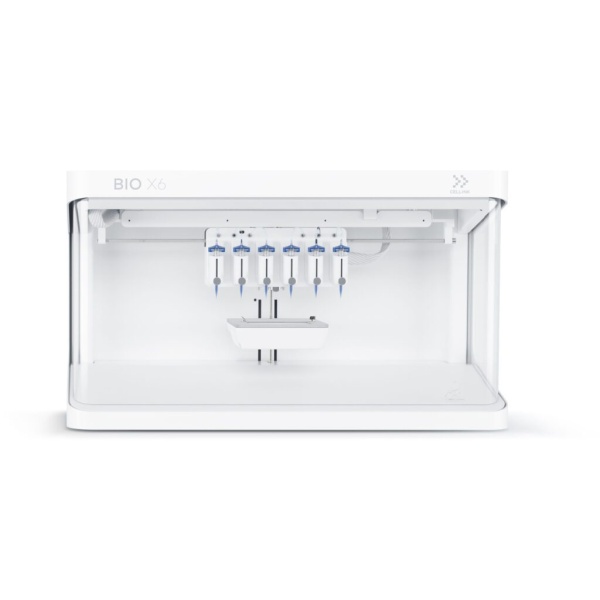
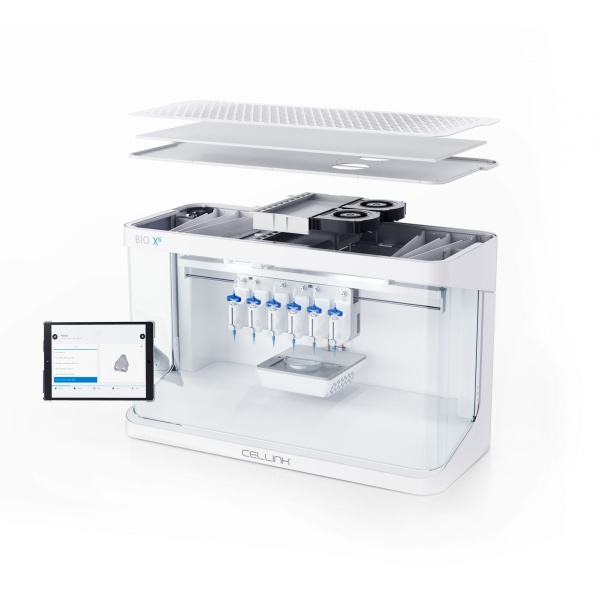
For simultaneous use of several materials, thermoplastic extrusion, coaxial printing or a broader set of interchangeable toolheads, consider the CELLINK BIO X or BIO X6.
Frequently asked questions
Is BIO ONE a bioprinter or a biodispenser?
CELLINK positions BIO ONE as a biodispenser within its current portfolio, while its technical specification describes temperature-controlled syringe-based 3D bioprinting. For APEL content, the clearest description is a temperature-controlled biodispenser and entry platform for reproducible 3D cell culture.
Can BIO ONE print collagen and Matrigel?
The cooled printhead is designed for temperature-sensitive materials such as collagen and Matrigel. The final protocol still depends on material formulation, viscosity, cell concentration, nozzle, flow rate and the required geometry.
Does BIO ONE support high-throughput plates?
Yes. The stated build-surface compatibility includes multi-well plates from 6 to 384 wells. The practical workflow and number of printable positions depend on the selected plate and construct geometry.
Request a configuration
APEL Laser can help assess material compatibility, culture format, dispensing volume, thermal requirements and the most appropriate CELLINK platform. Contact the APEL Laser team or email sales@apellaser.ro.
| Manufacturer | CELLINK |
|---|---|
| Applications / Industries | Bioprinting of tissues for the study of diseases, Biotechnology, Cell biology, Drug testing, Models and Tissue Engineering, Pharmaceutical Industry |