



BIO X Gen 3 Bioprinter | CELLINK
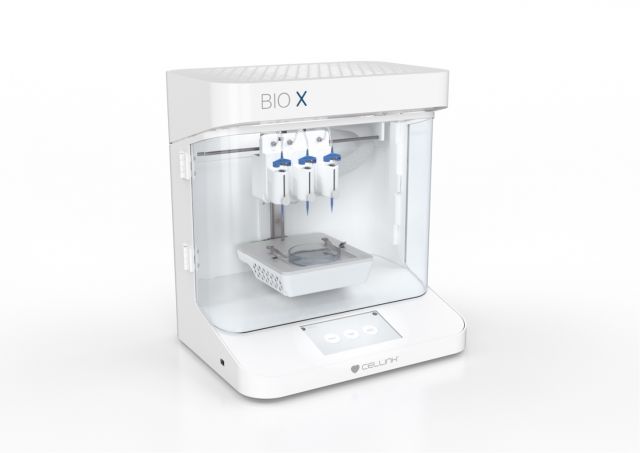
The CELLINK BIO X Gen 3 is a modular extrusion-based 3D bioprinter for cell biologists, tissue engineers, biomedical researchers and material scientists who need flexibility across materials and fabrication methods. Three interchangeable printhead slots allow researchers to combine different extrusion modalities and crosslinking tools within one protocol.
Key benefits
- Three modular printhead slots: Configure multimaterial and multicellular protocols with up to three interchangeable printheads or toolheads.
- Multiple fabrication modalities: Available options include pneumatic, thermoplastic, temperature-controlled and syringe-pump extrusion, a droplet printhead and photocuring toolheads.
- Open material system: Develop custom materials or use ready-to-print and tissue-specific bioinks.
- Broad thermal control: Printhead-dependent operation from 4 to 250 °C and a temperature-controlled printbed from 4 to 65 °C.
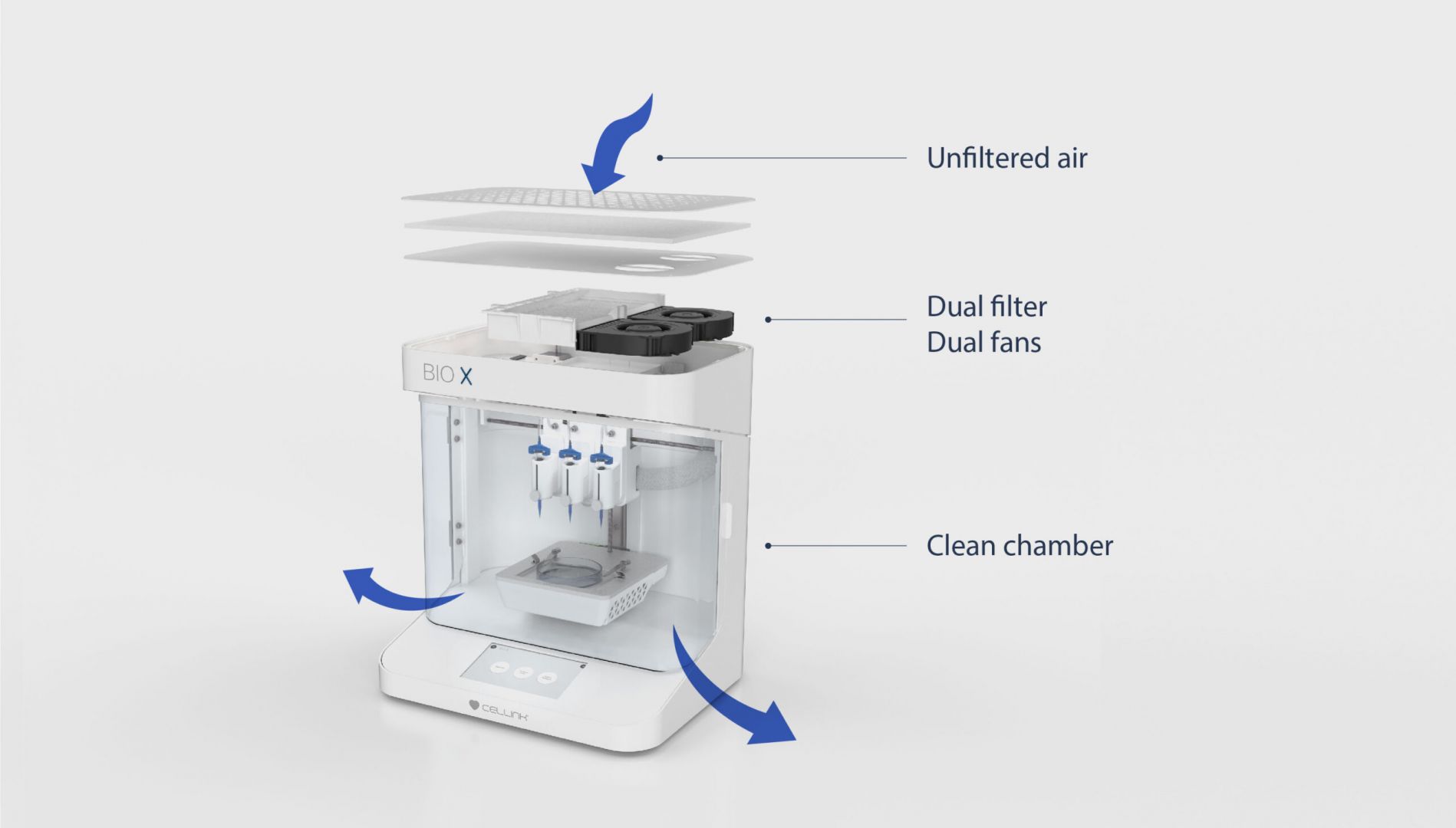
- Clean Chamber technology: HEPA H14 filtration, UV-C sterilisation and an enclosed, cleanable working chamber support cleaner workflows.
- Automated calibration: Manual and automatic calibration options simplify setup when changing tools or build surfaces.
- DNA Studio 4: Configure materials, toolpaths, crosslinking steps and saved protocols from the integrated touchscreen or desktop application.
Intelligent Printheads and toolheads
The BIO X platform can be configured with interchangeable tools selected for the material and process. The current BIO X Series brochure describes pneumatic extrusion, thermoplastic extrusion, temperature-controlled extrusion, syringe-pump extrusion, droplet dispensing and photocuring options. Wavelength options for photocuring toolheads include 365, 405, 450, 485 and 520 nm, while the built-in photocuring modules are specified at 365, 405, 485 and 520 nm.
The configuration should be defined around the material viscosity, required temperature, cell sensitivity, desired extrusion mechanism, crosslinking chemistry and construct geometry. Not every printhead operates across the full stated temperature range.
Applications
- Multimaterial and multicellular 3D bioprinting
- 3D cell culture and tissue-model development
- Tissue engineering and regenerative-medicine research
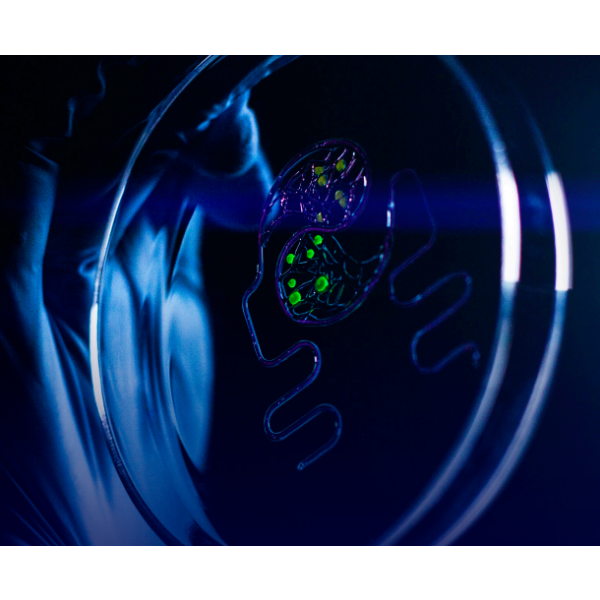
- Organ-on-a-chip and microfluidic biofabrication
- Drug-delivery systems and hydrogel drug encapsulation
- Soft robotics, biosensors and functional biomaterials
- Bioink, polymer and composite-material development
- Food-alternative and cell-cultured material research
Technical specifications
| Parameter | Manufacturer specification |
| Outer dimensions | 484 × 441 × 365 mm, L × W × H |
| Weight | 18.4 kg |
| Build volume | 128 × 85 × 30 mm* |
| Build surfaces | multi-well plates, Petri dishes and glass slides |
| Theoretical XY resolution | 1 µm |
| Theoretical layer resolution | 1 µm |
| Internal pressure range | 0–200 kPa |
| External-air pressure range | 0–700 kPa |
| Printhead slots | 3 |
| Built-in photocuring sources | 365, 405, 485 and 520 nm |
| Printbed temperature range | 4–65 °C; lowest temperature 17 °C below chamber temperature |
| Printhead temperature range | 4–250 °C, printhead-specific |
| Chamber filtration | HEPA H14 |
| UV sterilisation | UV-C, 275 nm |
| Calibration | manual and automatic |
| User interface | integrated touchscreen and DNA Studio desktop application |
| Connectivity | Ethernet |
| Supported model formats | .gcode, .stl, .amf, .3mf, .obj |
*Build height is stated for a standard nozzle, pneumatic printhead and Petri dish. CELLINK indicates that larger constructs up to 47 mm may be possible after consultation. Theoretical motion and layer resolution should not be interpreted as guaranteed biological feature size; actual performance depends on the complete process.
When should a laboratory choose BIO X?
BIO X is the balanced option for laboratories that require flexible extrusion bioprinting and up to three materials or tools in a protocol. It offers broader process capability than BIO ONE without the footprint and six-head architecture of BIO X6.
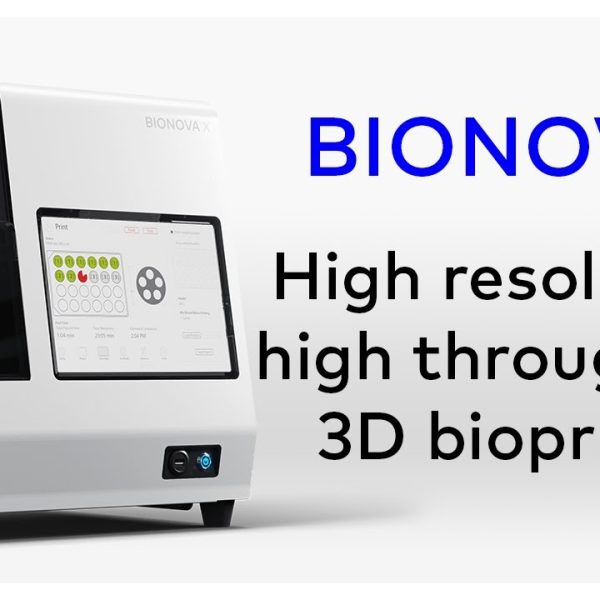
Choose BIO X6 when the research requires six printhead positions, higher parallelism, independent dual-pressure control, coaxial printing or mixing workflows. For light-based fabrication, compare LUMEN X Gen 3 and BIONOVA X.
Frequently asked questions
How many printheads can BIO X use?
BIO X has three modular printhead slots. The tools can be selected according to the extrusion mechanism, temperature range, material and crosslinking method.
Is BIO X an open material platform?
Yes. BIO X is designed to work with CELLINK bioinks and user-developed materials. Process compatibility still needs to be established for the actual formulation, cells and geometry.
What does the stated 1 µm resolution mean?
The manufacturer specifies theoretical XY positioning resolution and theoretical layer resolution of 1 µm. These values are not equivalent to a guaranteed printed feature size, which also depends on nozzle diameter, material rheology, extrusion conditions, toolpath and post-print behaviour.
Request a configuration
APEL Laser can help select printheads, crosslinking wavelengths, pressure sources, build surfaces and material workflows. Contact APEL Laser or email sales@apellaser.ro.
| Manufacturer | CELLINK |
|---|---|
| Applications / Industries | 3D Cell Culture, Biotechnology, Medical Imaging and Instrumentation, Micro/soft robotics, Models and Tissue Engineering, Pharmaceutical Industry, Transportation of Medicines |
| Weight | 25 kg |
Related products