
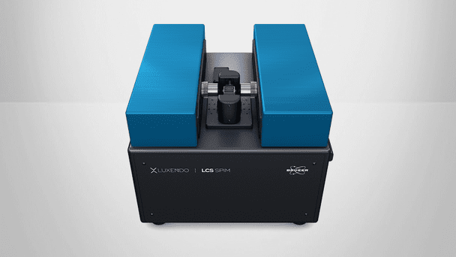
Bruker LCS SPIM Light-Sheet Microscope
(I) Description:
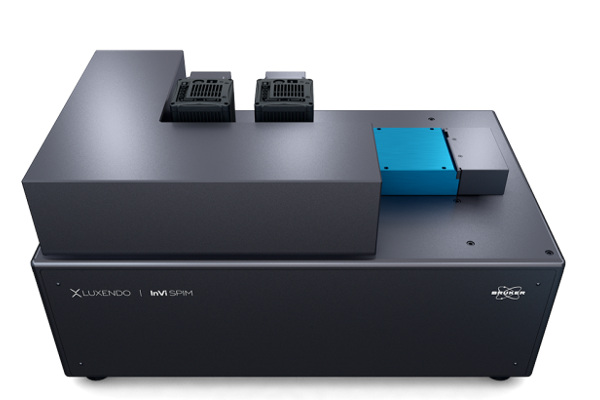
The Bruker Luxendo LCS SPIM is a compact light-sheet microscope specifically developed for large optically cleared samples. Designed with feedback from users in the lab, the LCS SPIM is easy to clean and maintain to ensure safe handling of clearing liquids. The LCS SPIM is compatible with all currently available clearing solutions which makes it an optimal system for multi-user environments and experiments using different clearing approaches. Flexible embedding options also support small and large samples. Overall, an inverted optical concept, three objective lenses, dual-side illumination, and single-side detection ensure low sample distortion, a fast-imaging option, and an extended field-of-view (FOV). The LCS SPIM is the ideal microscope for high-throughput studies and multi-user environments.
(II) Features and Benefits:
- Fast, high-resolution 3D imaging of large cleared specimens
- Dual-sided illumination for improved image uniformity and reduced shadowing
- High-throughput acquisition of whole organs, brains, embryos, and organisms
- Dual-destriping and TAG-lens (tuneable acoustic gradient lens) technologies for uniform light-sheet illumination
- Compatibility with a wide range of tissue-clearing methods and refractive indices
- Exchangeable quartz cuvettes for different sample sizes
- Compact, stable benchtop design for routine multi-user operation
- Integrated LuxBundle software for acquisition, stitching, processing, and 3D visualization
(III) Technical Specifications
- Imaging modality: Light-Sheet Fluorescence Microscopy for large optically cleared samples
- Optical geometry: Inverted configuration with dual-sided illumination and single-sided detection
- Illumination: Two opposing scanned Gaussian light sheets
- Illumination objectives: 2 × Nikon 4× / 0.20 NA air objectives
- Detection objective: Olympus 4× / 0.28 NA air/dry objective
- Effective magnification:2×, 4.4×, 6.7×, and 8.9×
- Field of view: 5990 µm at 2.2×; 2995 µm at 4.4×; 1997 µm at 6.7×; and 1497 µm at 8.9×
- Effective pixel size: 2925 nm at 2.2×; 1463 nm at 4.4×; 975 nm at 6.7×; and 731 nm at 8.9×
- Optical resolution:1 µm
- Detection: High-efficiency scientific CMOS camera with a 10-position high-speed emission filter wheel
- Destriping: Dual-destriping technology combining pivot scanning and beam swiping to reduce shadowing and striping artifacts
- Light-sheet control: TAG-lens technology for axial scanning and adjustment of light-sheet length and uniformity
- Fast-imaging mode: Axial movement of the light sheet extends the effective illumination field and reduces the number of required acquisitions
- Sample chambers: Three exchangeable closed quartz-crystal cuvettes, ranging from 20 × 20 × 20 mm to 100 × 30 × 30 mm
- Refractive-index compatibility: Approximately 1.33–1.58 and above, supporting a wide range of aqueous and solvent-based tissue-clearing protocols
- Sample positioning: Motorized sample stage with precision piezo-crawler positioning
- Excitation: Flexible and upgradeable laser configuration; available wavelengths depend on the selected system configuration
- Software: Bruker LuxBundle for acquisition, multicolor alignment, tile stitching, post-processing, and 3D visualization of large datasets
- System design: Compact, vibration-free benchtop configuration with Class 1 laser safety
(IV) Manufacturer
Bruker
(V) Applications
Cleared-Tissue Imaging, Whole-Organ Imaging, Whole-Brain Imaging, Whole-Organism Imaging, Neuroscience, Neuroanatomy, Developmental Biology, Embryology, Cancer Biology, Vascular Research, Pharmacokinetics, Biodistribution Studies, 3D Histology, Expansion Microscopy, Spatial Biology