


Blog
TSI range for cleanroom contamination monitoring
Cleanroom particle counters: how to choose the right system from the TSI range
Contamination control in a cleanroom is not simply a matter of selecting one particle counter. Periodic classification, continuous monitoring, contamination-source investigation, nanoparticle detection and microbiological monitoring are different tasks that require different technologies and system configurations.
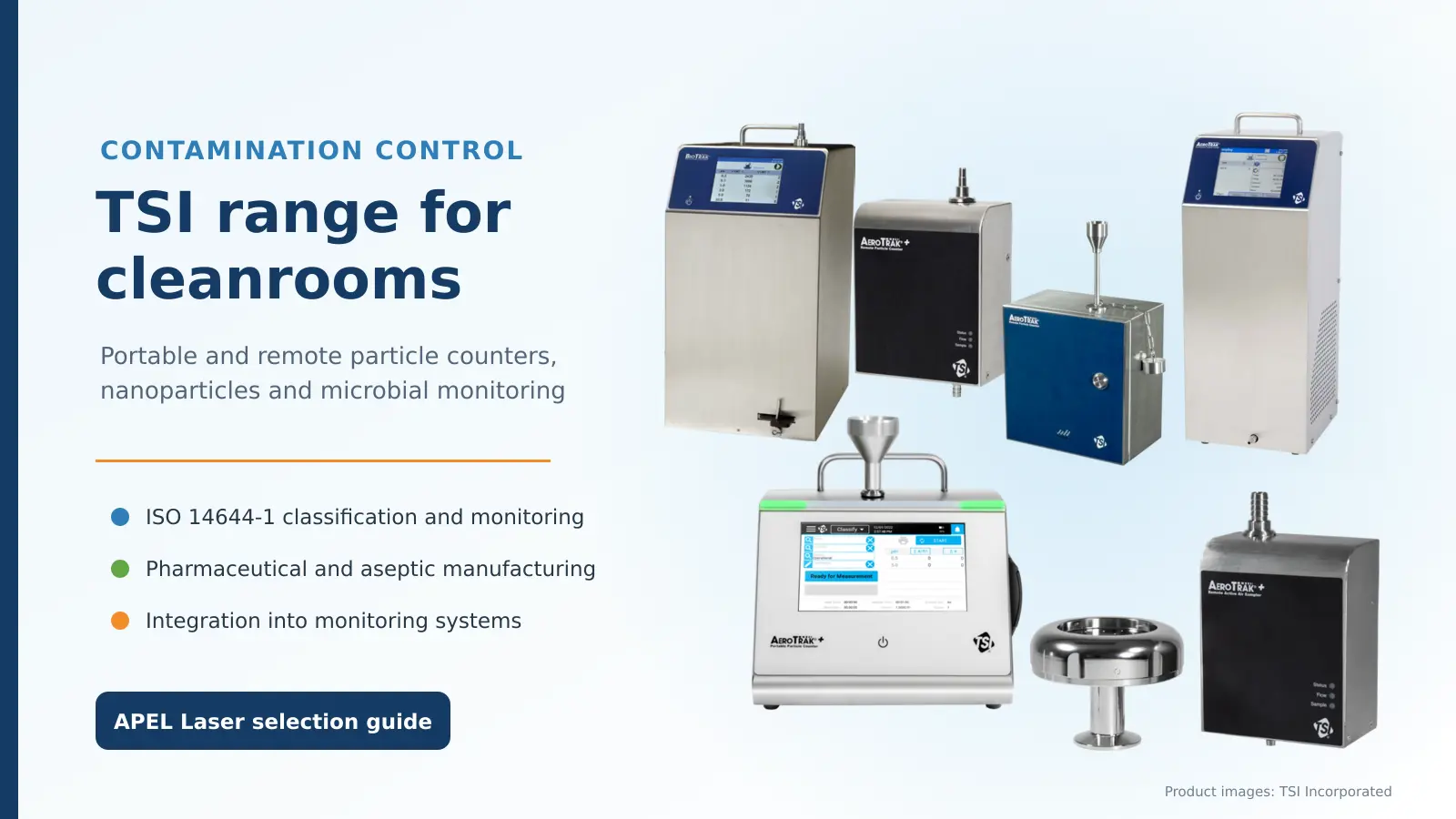
The TSI cleanroom range includes portable instruments, remote particle counters with integrated pumps, a condensation particle counter capable of detecting particles from 10 nm, a real-time biofluorescent particle detection system and a remote active air sampler for agar plates. Together, these instruments can support applications in pharmaceutical manufacturing, medical-device production, microelectronics, semiconductors, optics, nanotechnology, aerospace and laboratories with controlled environments.
In brief: A100 is the flexible choice for classification and investigations. The 6000 and 6310–6510 Series are designed for fixed monitoring points. AeroTrak 9001 extends particle measurement down to 10 nm. BioTrak provides real-time total and biofluorescent particle signals, while AeroTrak+ 7010 performs active microbiological air sampling onto agar plates.
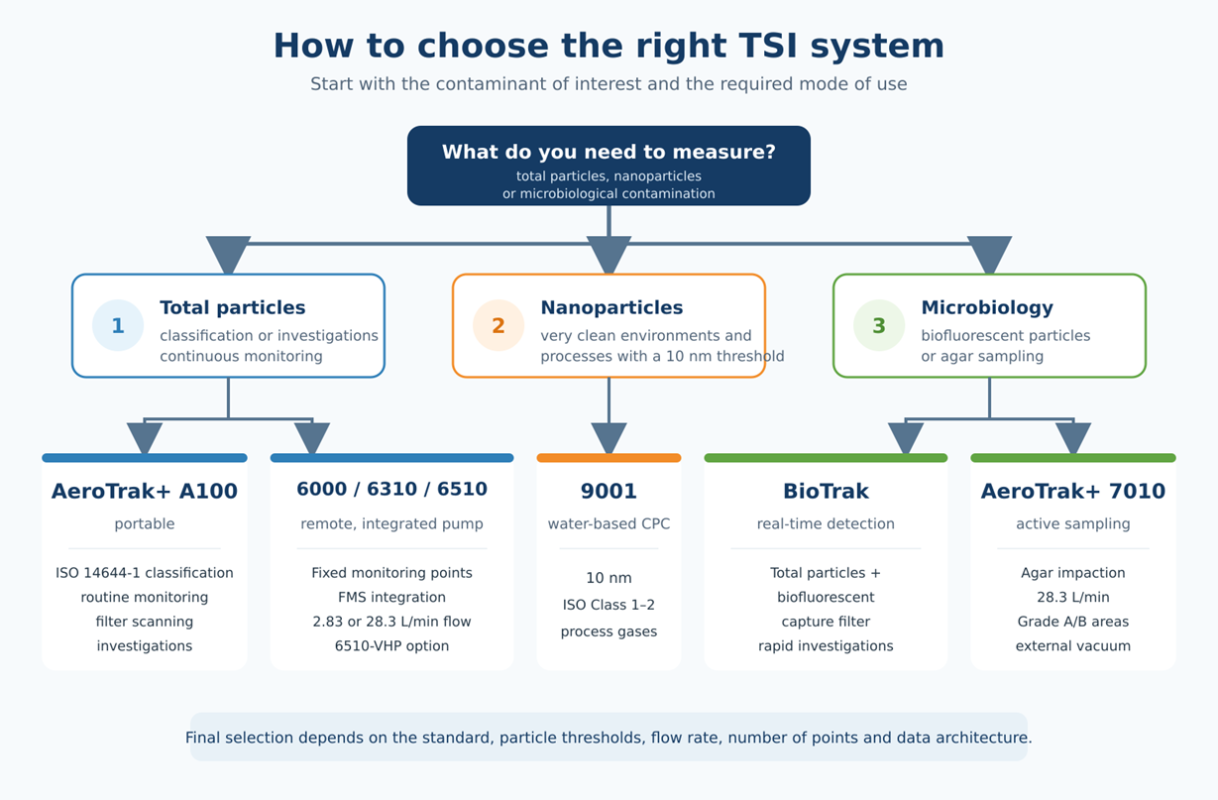
Start with the contaminant of interest and the required mode of use.
Why is there no single particle counter for every cleanroom application?
The selection should begin with the decision that the measurement needs to support:
- For cleanroom classification or measurements across multiple locations, a portable instrument is generally the most suitable option.
- For continuous monitoring, remote counters installed at fixed points and connected to a central system are usually preferred.
- Where contamination by very small particles is critical, a conventional optical particle counter may not be sufficient; condensation technology may be required.
- For microbiological monitoring, total particles, a biofluorescent signal and culture results from agar plates provide different and complementary information.
Quick comparison of the TSI range
| Product family | Measurement type | Sample flow rate | Main use |
| AeroTrak+ A100 | total particles, portable instrument | 28.3 / 50 / 100 L/min, depending on model | classification, monitoring, filter scanning and investigations |
| AeroTrak+ 6000 Series | total particles, remote monitor with pump | 2.83 L/min | fixed points without an external vacuum network |
| AeroTrak 6310 / 6510 / 6510-VHP | total particles, remote monitor with pump | 28.3 L/min | continuous GMP and industrial monitoring |
| AeroTrak 9001 | ultrafine particles by condensation | 2.83 L/min | very clean environments, 10 nm detection threshold |
| BioTrak 9510-BD | total and biofluorescent particles | 28.3 L/min | real-time microbiological signal and investigations |
| AeroTrak+ 7010 | microbiological sampling by agar impaction | 28.3 L/min | active sampling in pharmaceutical Grade A and B areas |
AeroTrak+ A100: portable classification, monitoring and investigations
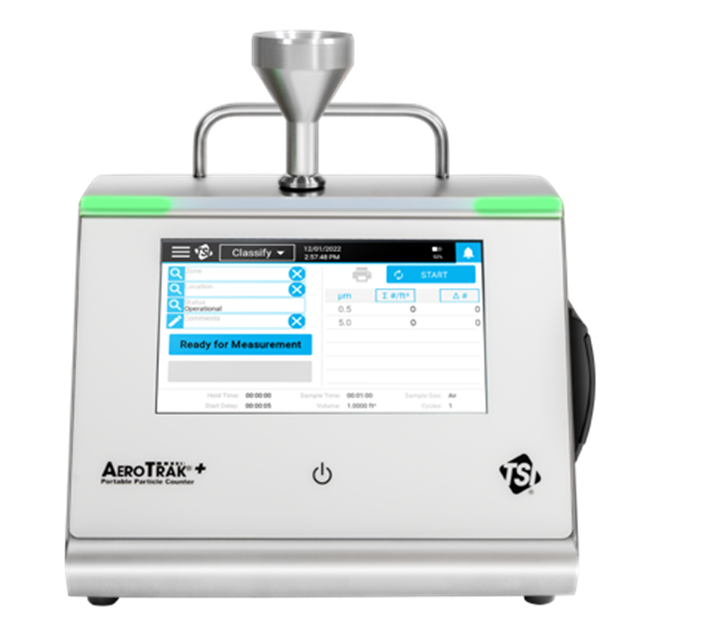
AeroTrak+ A100 for classification, monitoring and investigations.
The TSI AeroTrak+ A100 Series is a practical starting point for organisations that need one portable particle counter for several activities. It can be moved between rooms and sampling locations, making it suitable for cleanroom classification, routine checks, filter scanning and the investigation of an unexpected increase in particle concentration.
The family includes configurations with flow rates of 28.3, 50 and 100 L/min, as well as versions with lower thresholds of 0.3 or 0.5 µm. Six particle-size channels can be selected according to the model and protocol. The interface guides operators through measurement workflows, while ISO 14644-1 and GMP reporting helps reduce the risk of manual data transcription.
A100 is a good fit when:
- the same instrument must be used in several rooms;
- classification and periodic reclassification are required;
- the team needs to locate contamination sources or filter leakage;
- local visibility of the measurement status is important;
- a portable instrument is needed now, with the option of integrating it into a broader data workflow later.
AeroTrak+ 6000 Series: remote monitoring with an integrated pump at 2.83 L/min
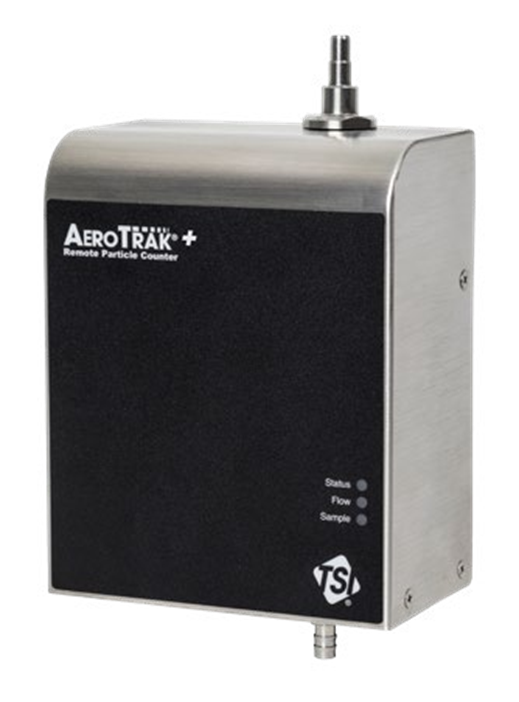
6000 Series for fixed monitoring points at 2.83 L/min.
The AeroTrak+ 6000 Series is intended for fixed monitoring points where an external vacuum network is not available. The integrated pump simplifies installation and allows the instrument to be relocated if the production flow or room configuration changes.
Models 6201, 6301 and 6501 cover lower particle-size thresholds of 0.2, 0.3 or 0.5 µm at a flow rate of 2.83 L/min. The appropriate model depends on the critical particle sizes and the industry, including semiconductor manufacturing, electronics, optics, aerospace, automotive, pharmaceutical production and other controlled manufacturing environments.
The series provides local data storage, Ethernet communication and integration options for TSI FMS or third-party systems. For an overview of the available instruments, see the APEL Laser particle counters category.
The 6000 Series is a good fit when:
- fixed monitoring points with a 2.83 L/min flow rate are required;
- no central vacuum source is available;
- particles from 0.2, 0.3 or 0.5 µm need to be monitored, depending on the model;
- the installation must be expanded gradually with limited infrastructure;
- data must be transferred to a monitoring platform.
AeroTrak 6310, 6510 and 6510-VHP: 28.3 L/min continuous monitoring
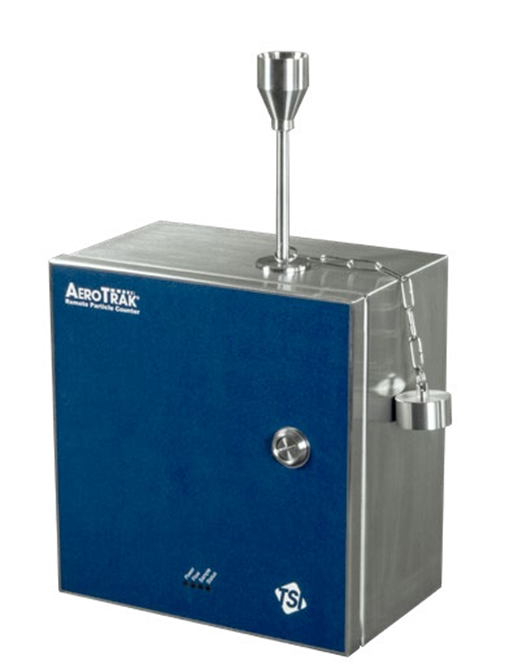
AeroTrak 6310, 6510 and 6510-VHP for monitoring at 28.3 L/min.
The AeroTrak 6310, 6510 and 6510-VHP models combine a 28.3 L/min flow rate with an internal pump. They are designed for continuous monitoring in GMP areas, isolators, RABS, laboratories and industrial processes where an external vacuum system is not available.
The 6310 measures particles from 0.3 µm and is suitable where fine-particle thresholds are a priority. The 6510 and 6510-VHP measure from 0.5 µm and include the 5 µm channel frequently used in pharmaceutical monitoring. The 6510-VHP version is intended for areas using vaporised hydrogen peroxide decontamination cycles, within the conditions and limits defined by the manufacturer.
The 316L stainless-steel enclosure and tool-free replaceable optics-and-pump assembly support cleaning and maintenance. The 4–20 mA inputs allow compatible environmental sensors to be incorporated, while Ethernet and Modbus communication facilitate connection to FMS.
Until a dedicated APEL product page is published for this family, the models can be found through the particle counters category.
AeroTrak 9001: nanoparticle measurement from 10 nm
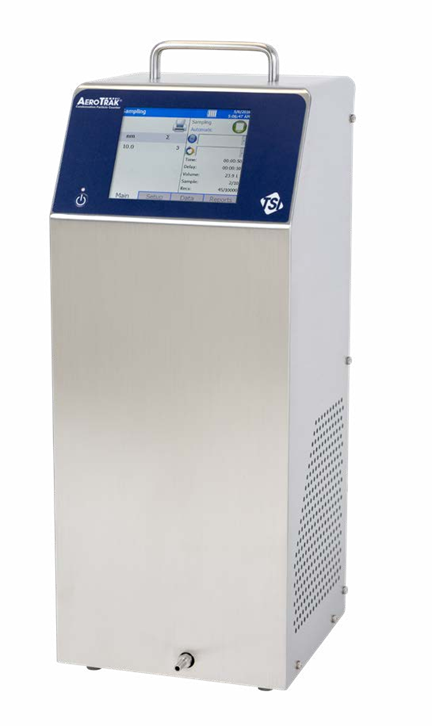
AeroTrak 9001 measures particles down to 10 nm.
The TSI AeroTrak 9001 is a water-based condensation particle counter. Instead of directly measuring a 10 nm particle through light scattering, it enlarges the particle through water-vapour condensation and then counts it optically.
Its 10 nm sensitivity, 2.83 L/min flow rate and low false-count rate make it suitable for environments with very low particle concentrations, including ISO Class 1 and 2 areas, mini-environments and process-gas monitoring. A compatible high-pressure diffuser can be used to measure pressurised gases such as clean dry air, nitrogen or argon.
AeroTrak 9001 should be considered when:
- conventional submicron particle measurements do not adequately describe the process risk;
- the process may generate nanoparticles;
- extremely clean environments must be monitored;
- water is preferred as the working fluid;
- integration into a monitoring system is required.
BioTrak 9510-BD: total and biofluorescent particles in real time
BioTrak combines total counting, a biofluorescent signal and filter capture.
The BioTrak Real-Time Viable Particle Counter combines three functions in one instrument: total particle counting, detection of a biofluorescent signal using laser-induced fluorescence, and particle capture on a 37 mm filter for subsequent analysis.
The instrument operates at 28.3 L/min and measures particles from 0.5 to 25 µm. Two fluorescence channels and one sizing channel contribute to signal discrimination. Results are available in real time, helping the team identify an event sooner, investigate its cause and monitor the effect of corrective actions.
BioTrak can operate as a standalone instrument or as part of TSI FMS. The biofluorescent signal should not automatically be presented as equivalent to a colony-forming unit, and installation alone does not replace conventional microbiological methods. Any use as a rapid microbiological method should be evaluated, qualified and validated for the specific process and applicable requirements.
AeroTrak+ 7010: active air sampling onto agar plates
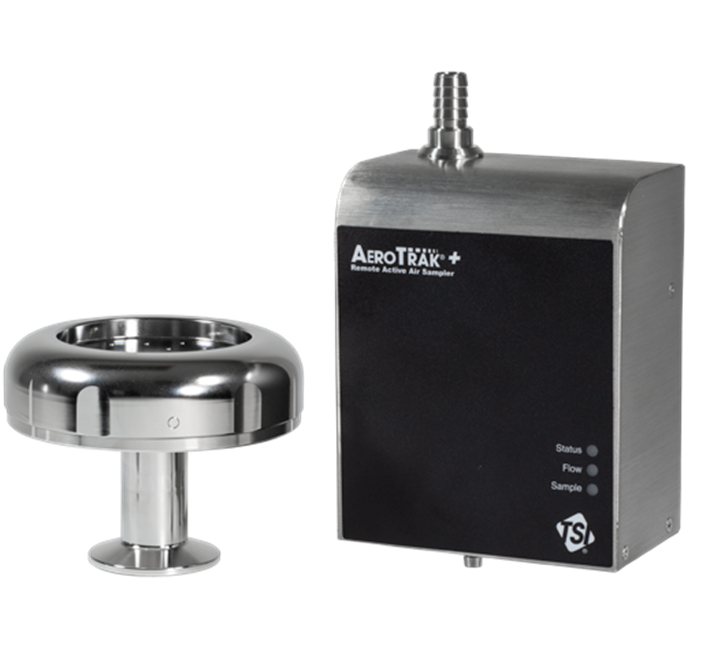
AeroTrak+ 7010 for active microbiological air sampling.
The TSI AeroTrak+ 7010 is an active air sampler, not an optical particle counter. It draws air at 28.3 L/min and collects microorganisms by impaction onto a 90 mm agar plate, which is then incubated and evaluated according to the laboratory procedure.
The instrument is designed for microbiological monitoring in aseptic pharmaceutical manufacturing, including Grade A and B areas with an external vacuum source. Active flow measurement and associated alarms can indicate vacuum loss, obstructed tubing or other conditions that could compromise sampling.
When integrated into TSI FMS, sampling data can be correlated with information from particle counters and other environmental sensors. Total-particle monitoring and microbiological monitoring can therefore be managed within a common architecture.
How the instruments work together in a monitoring system
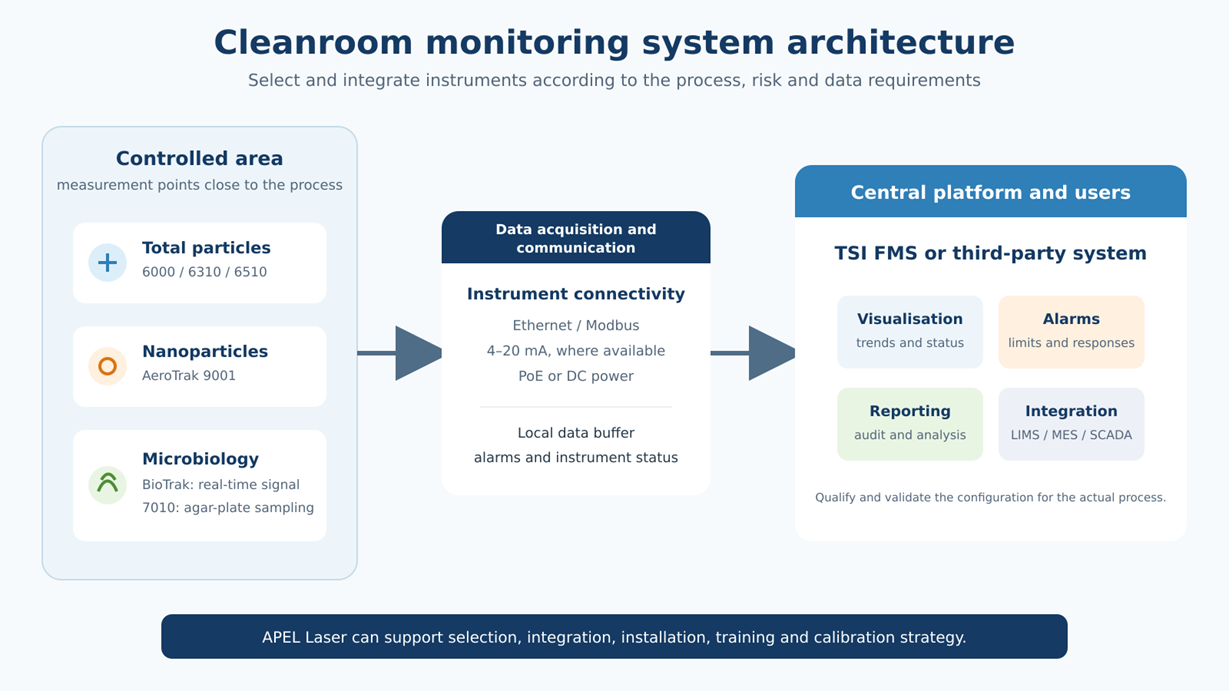
A complete system does not require every instrument to be installed at every location. The architecture should be based on a risk assessment and may include:
- an AeroTrak+ A100 for classification, periodic checks and investigations;
- 6000 Series or 6310–6510 remote counters at critical monitoring points;
- AeroTrak 9001 where nanoparticles are relevant to the product or process;
- BioTrak for real-time biofluorescent information and investigations;
- AeroTrak+ 7010 for microbiological air sampling onto agar plates;
- TSI FMS or a compatible platform for centralised data, alarms and reporting.
Instruments send data to FMS or a compatible central system.
Probe location, tubing length and routing, flow rate, particle losses, response times, alarm limits, user permissions and data transfer must be defined for the actual installation. In regulated applications, the configuration and data flow should be included in the qualification and validation strategy.
Particle-detection technologies explained
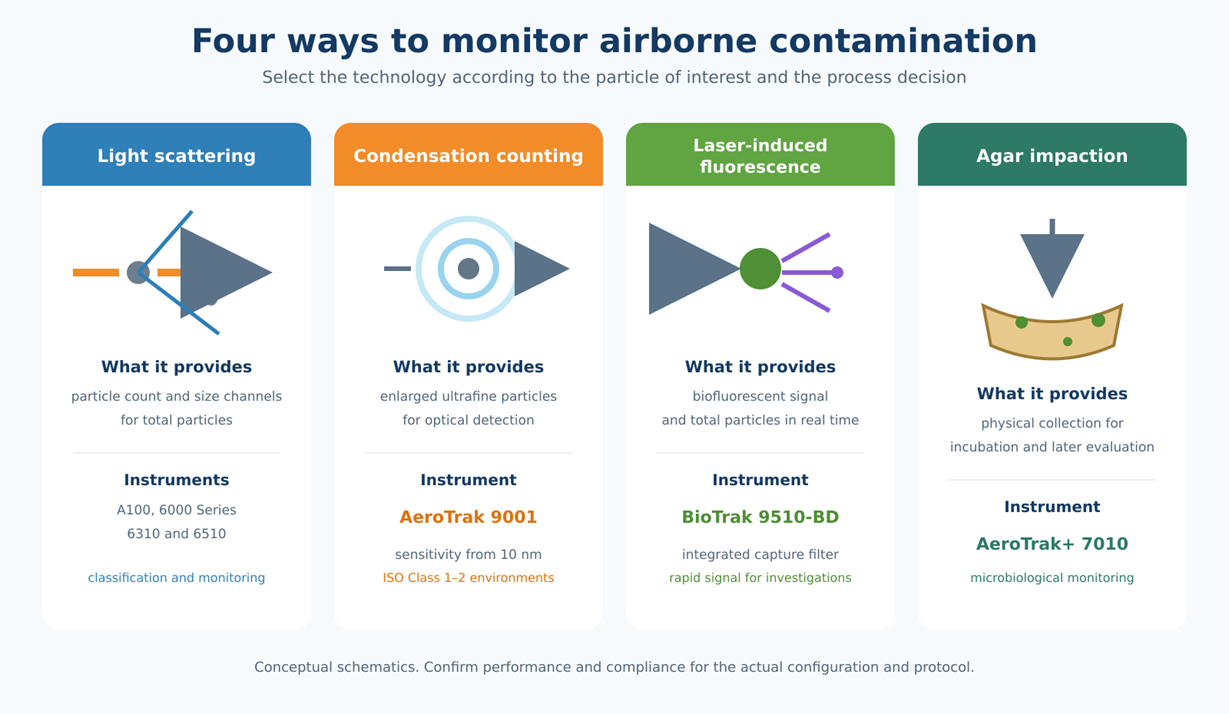
TSI technologies provide different and complementary information.
- Light scattering: particles cross a laser beam, and the scattered light is converted into pulses used for counting and particle-size classification.
- Condensation particle counting: nanoparticles are enlarged by condensing a working fluid onto them, allowing optical detection.
- Laser-induced fluorescence: particles are optically excited, and the fluorescence signal is used to identify biofluorescent particles.
- Agar impaction: air passes through a sampling head, and microbiological particles are collected on culture media for incubation and subsequent evaluation.
These technologies do not provide the same type of result. Selection should be based on the process question, not only on the smallest particle size stated in a data sheet.
Questions to answer before selecting a configuration
At least the following information is needed to define the system correctly:
- Which standard, guidance document or internal procedure must be followed?
- What particle sizes and critical limits apply?
- Is periodic classification, continuous monitoring or both required?
- What sample flow rate is required at each point?
- How many sampling points are needed, and where should they be located?
- Is an external vacuum network available?
- Are VHP decontamination cycles used?
- Must temperature, humidity, differential pressure or other sensors be integrated?
- Which system will manage alarms, users, reports and data history?
- Which installation, training, calibration, qualification and maintenance activities should be included?
Frequently asked questions
What is the difference between a portable and a remote particle counter?
A portable counter such as A100 can be moved between locations and is suited to classification and investigations. A remote counter is installed at a fixed point and sends data to a central system for continuous monitoring.
Which TSI instrument measures particles down to 10 nm?
AeroTrak 9001 uses water-based condensation technology and has a D50 detection threshold of 10 nm.
Does BioTrak automatically replace microbiological sampling onto agar?
No. BioTrak provides a real-time signal for biofluorescent particles and can capture particles for further analysis. Its use as a rapid microbiological method must be evaluated and validated for the specific application. Agar sampling with the 7010 provides a different type of result.
Which models are suitable for continuous monitoring at 28.3 L/min?
Models 6310, 6510 and 6510-VHP operate at 28.3 L/min and include an integrated pump. Selection depends on the lower particle-size threshold, the required channels and compatibility with the decontamination environment.
Can the TSI range be integrated into a central monitoring system?
Yes. Several instruments can be connected to TSI FMS or, depending on the model and configuration, to third-party platforms through Ethernet, Modbus, OPC UA or analogue signals. The exact architecture should be confirmed before ordering.
Do you need to configure a cleanroom monitoring system?
Send us the details and the APEL Laser team will help you in selecting the right instruments and architecture.

