

BIO X6™ | CELLINK
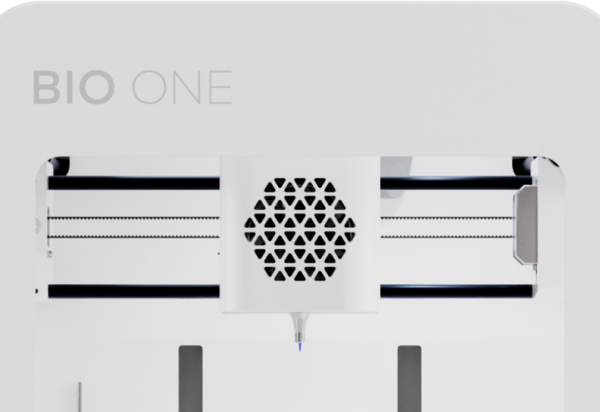
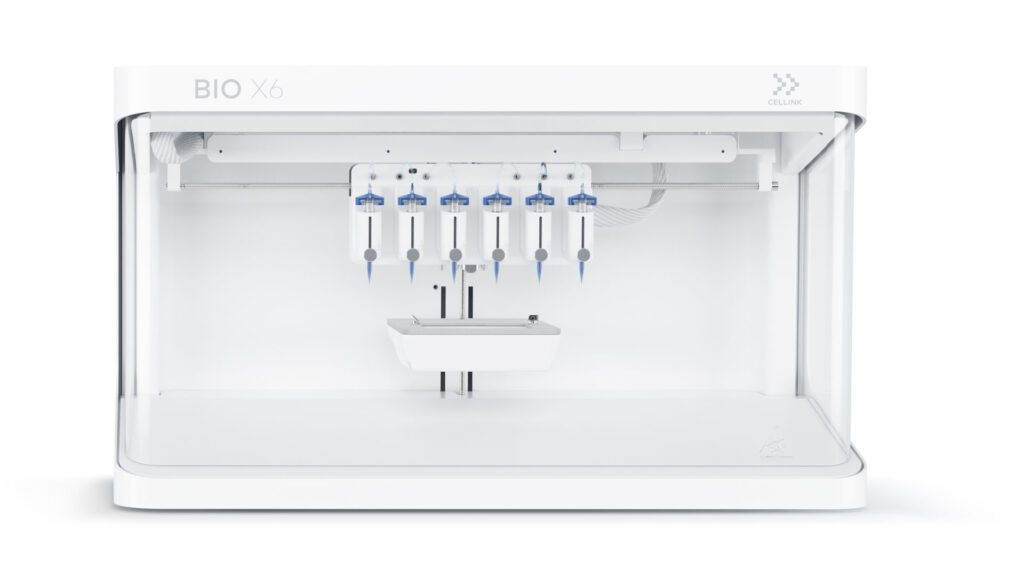
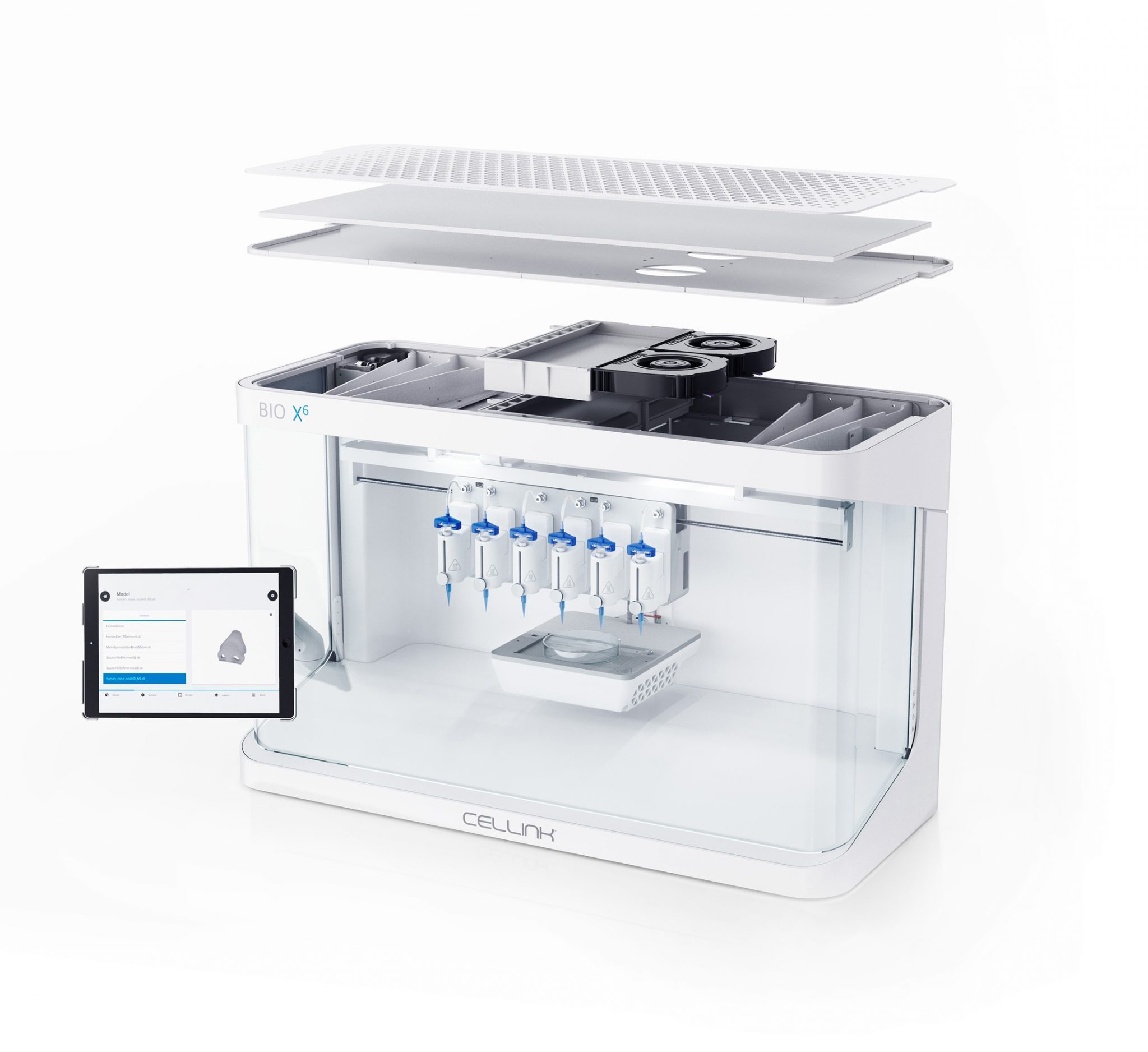
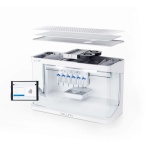
The CELLINK BIO X6 Gen 3 expands the BIO X architecture to six modular printhead slots for researchers who need more materials, cells, tools or crosslinking steps within a single biofabrication workflow. The platform supports complex multimaterial constructs while reducing manual tool changes and allowing more operations to be integrated into one protocol.
Independent dual-pressure regulation enables coaxial and mixing workflows. Combined with interchangeable pneumatic, mechanical, temperature-controlled, thermoplastic, droplet and photocuring tools, BIO X6 can be configured for heterogeneous constructs and advanced process development.
Resources:
Key benefits
- Six modular printhead positions: Combine multiple materials, cell populations and fabrication tools within one construct.
- Coaxial and mixing printing: Independent dual-pressure control supports core-shell structures, mixing and advanced extrusion strategies.
- Higher workflow throughput: Multiple loaded printheads reduce tool changes and can shorten complex multimaterial protocols.
- Open material platform: Use CELLINK bioinks or develop custom hydrogels, polymers, composites and sacrificial materials.
- Broad thermal control: Printhead-specific temperatures from 4 to 250 °C and printbed control from 4 to 65 °C.
- Integrated crosslinking: Built-in 365, 405, 485 and 520 nm modules support wavelength-matched photocuring workflows.
- Clean Chamber technology: Four fans, HEPA H14 filtration, UV-C sterilisation and rounded internal surfaces support cleaner operation.
- DNA Studio 4: Define multimaterial protocols, crosslinking steps, material settings and reusable print workflows.
Advanced multimaterial workflows
BIO X6 is relevant when the construct requires more than three materials or tools, when coaxial geometries are needed, or when several process steps should be executed without manual reconfiguration. Potential workflows include sacrificial-channel fabrication, core-shell fibres, graded or heterogeneous tissue constructs, perfusable architectures and combinations of cell-laden and structural materials.
The number of available printhead positions does not by itself determine biological performance. Printhead selection, pressure, nozzle geometry, temperature, crosslinking dose and material compatibility must be developed for the actual application.
Applications
- Complex multimaterial and multicellular tissue constructs
- Coaxial, core-shell and mixing-based bioprinting
- Perfusable channels and vascularised tissue models
- Spheroid and organoid generation
- Organ-on-a-chip and microfluidic systems
- 3D models for drug discovery and bioassays
- Biosensors, soft robotics and functional materials
- Food alternatives and cell-cultured products
- Advanced bioink and process development
Technical specifications
| Parameter | Manufacturer specification |
| Outer dimensions | 800 × 400 × 500 mm, L × W × H |
| Weight | 47.4 kg |
| Build volume | 128 × 85 × 30 mm* |
| Build surfaces | multi-well plates, Petri dishes and glass slides |
| Theoretical XY resolution | 1 µm |
| Theoretical layer resolution | 1 µm |
| Internal pressure range | 0–200 kPa |
| External-air pressure range | 0–700 kPa |
| Printhead slots | 6 |
| Built-in photocuring sources | 365, 405, 485 and 520 nm |
| Printbed temperature range | 4–65 °C; lowest temperature 17 °C below chamber temperature |
| Printhead temperature range | 4–250 °C, printhead-specific |
| Chamber filtration | HEPA H14 |
| UV sterilisation | UV-C, 275 nm |
| Calibration | manual and automatic |
| User interface | DNA Studio desktop application |
| Connectivity | Ethernet |
| Supported model formats | .gcode, .stl, .amf, .3mf, .obj |
*Build height is stated for a standard nozzle, pneumatic printhead and Petri dish. CELLINK indicates that larger constructs up to 57 mm may be possible after consultation.
BIO X or BIO X6?
Choose BIO X when three printhead positions are sufficient and a smaller benchtop footprint is preferred. Choose BIO X6 when the workflow requires six loaded tools, greater multimaterial complexity, coaxial or mixing printing, independent dual pressure or fewer interruptions during complex protocols.
The systems share the open-material philosophy, broad thermal ranges, interchangeable tool ecosystem, Clean Chamber approach and DNA Studio workflow. Selection should therefore begin with the required process architecture rather than with the maximum number of printheads.
Frequently asked questions
Can BIO X6 perform coaxial bioprinting?
Yes. The platform uses independent dual-pressure regulation to support coaxial and mixing workflows when configured with the appropriate hardware and protocol.
Does BIO X6 require an external air supply?
The internal system provides pressure up to 200 kPa. The manufacturer specifies operation up to 700 kPa with an external air supply. The required pressure depends on the material, printhead, nozzle and flow conditions.
How is BIO X6 different from BIO X?
BIO X6 provides six rather than three printhead slots and adds the architecture for coaxial and mixing workflows with independent dual-pressure regulation. It is intended for more complex or higher-throughput multimaterial biofabrication.
Request a configuration
For a meaningful configuration, specify the materials, cells, number of printheads, desired extrusion modes, crosslinking wavelengths, nozzle sizes and build surfaces. Contact APEL Laser or email sales@apellaser.ro.
| Manufacturer | CELLINK |
|---|---|
| Applications / Industries | Bioprinting of tissues and artificial organs, Biotechnology, Cosmetic industry, Pharmaceutical Industry, Regenerative Medicine, Scientific research |
| Pixel resolution (XY) | 1 μm |