


Blog
How to select the right laser safety eyewear
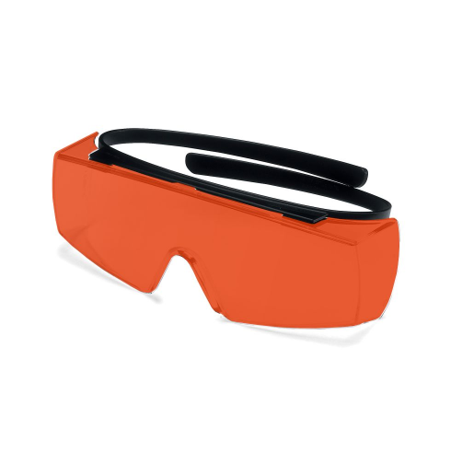
How to choose laser safety eyewear correctly: a practical, safety-first guide
Laser safety eyewear should not be selected from filter colour or one wavelength alone. A correct configuration must match the source, operating regime, accessible exposure and calculated protective marking. Laservision offers filter-and-frame combinations for laboratories, research, medicine and industrial processing, but every choice must be confirmed for the real application.
In brief: wavelength is only the starting point. Power or pulse energy, pulse duration, repetition rate, beam diameter and foreseeable exposure can completely change the required protection.
1. Begin with the risk assessment, not an eyewear model
Engineering controls take priority over personal protective equipment. Wherever practicable, enclose the beam, terminate it in a suitable beam dump and separate it from people with housings, screens or interlocks. Eyewear reduces residual risk; it does not make intentional beam viewing safe and does not replace restricted access, training or procedures.
Application-specific collective protection may include Laservision laser safety curtains or E25 modular laser safety barriers.
2. Identify every accessible emission
Record every wavelength that could reach a person during normal use, alignment, maintenance or a reasonably foreseeable event. Include the fundamental wavelength, harmonics, pilot or alignment beams and any integrated source. An Nd:YAG system may involve 1064 nm and one or more harmonics; invisible radiation is not less hazardous because it cannot be seen.
APEL Laser provides application pages for eyewear for 1064 nm lasers, eyewear for 532/1064 nm systems, eyewear for UV and excimer lasers, eyewear for CO₂ lasers and eyewear for ultrafast lasers. These define product families and do not replace the calculation for a specific system.
3. Collect the parameters that determine exposure
For each emission, use the maximum credible values rather than the usual operating setting:
- maximum continuous-wave power or maximum pulse energy;
- pulse duration, repetition rate and pulse trains;
- beam diameter at the potential eyewear position, divergence and working distance;
- assumed exposure duration and reasonably foreseeable specular or diffuse reflections;
- higher-access operations such as alignment, servicing, optic changes and reflective-workpiece processing.
A competent person or laser safety officer uses these inputs to determine exposure and the required protection. If they are unavailable, it is not safe to select eyewear from a wavelength-only table.
4. Understand OD and European markings
Optical density describes spectral attenuation: OD = −log₁₀(T), where T is transmittance. OD 3, for example, corresponds to 0.1% transmittance at the stated wavelength. This is useful information, but it does not by itself prove that the filter-and-frame assembly is suitable.
In the European Union, full-protection eyewear is checked against EN 207, while EN 208 applies to adjustment eyewear where the risk assessment supports that controlled task. EN 207 marking includes the wavelength range, D/I/R/M operating regime, LB level, manufacturer identification and CE marking. Both filter and frame matter.
Important: EN 208 is not full protection and does not permit intentional beam viewing. Adjustment eyewear is for a controlled task defined by the risk assessment and an approved procedure.
5. Select the filter only after defining the protection requirement
The filter must cover every required spectral range and carry markings at least equal to the calculated requirement for each relevant regime. Do not assume that eyewear for 1064 nm also protects at 532 nm, or that a continuous-wave rating is suitable for ultrafast pulses.
Visible light transmission, VLT, affects navigation, instrument reading and the likelihood that eyewear will be worn correctly. There is no universal 30% or 50% minimum. Among configurations that meet the protective requirement, choose suitable visibility, colour recognition and workplace illumination for the task.
6. Check frame fit, coverage and prescription compatibility
Certification and performance apply to the filter-and-frame assembly. The frame should provide the required lateral coverage, remain secure in the working position and be compatible with other PPE. OTG frames or prescription inserts may suit users who wear corrective spectacles. Comfort, field of view, weight and anti-fog performance matter because they influence consistent use.
7. Treat alignment, welding and ultrafast lasers as distinct cases
Alignment should use the lowest practicable emission, beam enclosure, beam blocks, suitable cameras or viewers and an approved procedure. Never assume diffuse reflections are safe: high-power lasers can produce hazardous diffuse exposure.
For handheld laser welding, eye protection must be integrated with face and head protection, screens, a controlled area and access management. Examples include the FS1 laser safety face shield and Panoramaxx laser welding helmet, but the configuration must be verified for the source and process. For ultrafast pulses, include the temporal regime and any nonlinear effects or harmonics generated in the setup.
8. Verify documents, markings and condition
For the EU market, verify CE marking, the EU Declaration of Conformity, manufacturer instructions and the complete assembly marking. Under Commission Implementing Decision (EU) 2026/1279, EN 207:2017 and EN 208:2009 remain the listed harmonised standards for these product categories. They should not be described as having been replaced by ISO 19818:2021.
- inspect the filter and frame before use;
- remove the product from service if it is cracked, deformed, discoloured or its marking is illegible;
- clean and store eyewear according to the manufacturer’s instructions;
- reassess the selection whenever the laser, optics, process or working method changes.
Checklist for requesting a recommendation
- Provide the laser datasheet and every accessible wavelength.
- State maximum power or pulse energy, pulse duration and repetition rate.
- Describe beam diameter, working distance and the operation performed.
- Identify reflections, harmonics, alignment and servicing conditions.
- State frame, prescription-eyewear, VLT and colour-recognition needs.
- Request confirmation of the complete configuration and marking before ordering.
For a documented selection, contact APEL Laser and send the application parameters. You can also read about biological risks and technological solutions for eye safety.
Frequently asked questions
Can eyewear be selected from wavelength alone?
No. Wavelength is necessary, but power or energy, pulse parameters, beam diameter, accessible exposure and operating regime also determine the requirement.
Is a higher OD always safer?
Not automatically. Higher OD can reduce visibility, while European selection must verify the EN marking and LB/RB level of the certified assembly rather than OD alone.
Does EN 208 provide full protection?
No. EN 208 covers eyewear for controlled adjustment work. Its use must be justified by the risk assessment and alignment procedure.
Is CE marking enough to select eyewear?
No. CE supports regulatory conformity, but the complete marking must match the wavelength, operating regime and required protection level.
Can the same eyewear be used after modifying the system?
Only after reassessment. Changes to the source, optics, power, pulse regime or process may alter the exposure and required protection. with laser eyewear you can trust from Apel Laser.

