


Blog
Coherent Laser Integration for Industrial Applications

How APEL Laser turns a Coherent laser source into a repeatable industrial process through testing, validation, design, integration, and service.
From laser source to production process: integrating Coherent lasers into industrial applications
A high-performance laser source is only the starting point. To become part of a reliable industrial process, it must be selected, tested, and integrated with suitable optics, motion control, tooling, extraction, vision, software, and safety systems. APEL Laser covers this complete route, integrating Coherent sources into workstations developed for real production requirements.
We operate both as a laser system integrator and as a process development partner. For machine builders and purchasing teams, this means one technical counterpart for the stages that connect an initial sample test with production-ready equipment.
Why the laser source cannot be selected separately from the application
Many projects begin with a request for a particular laser technology or power level. However, the correct choice depends on how the material absorbs energy, the required processing mechanism, part geometry, quality criteria, and target cycle time. Wavelength, pulse duration, beam quality, spot size, and scanning strategy must be evaluated together.
We therefore do not assume that the source initially requested is automatically the optimum solution. If testing shows that another configuration can deliver better quality, higher throughput, or simpler integration, we explain the technical and commercial reasoning.
When to use a fiber laser and when to use a CO₂ laser
Fiber lasers for metals and precision processes
Fiber lasers are widely used for metal processing, permanent marking, serialization, cutting, drilling, ablation, structuring, and selected cleaning operations. Their beam quality and fiber delivery make them suitable for compact workstations and automated production lines.
APEL Laser can configure Coherent fiber lasers with processing heads, galvo scanners, and positioning systems. For precision cutting and welding, PowerLine FL provides an integration-oriented platform, while Edge Fiber Laser covers higher-power cutting requirements. The wider Coherent fiber laser portfolio supports source selection based on beam characteristics, power, and process needs.
CO₂ lasers for polymers, films, composites, and organic materials
CO₂ lasers remain an important solution for cutting, perforating, engraving, marking, scoring, and selectively removing layers from materials that absorb infrared radiation efficiently. These include many polymers, films, composites, paper products, textiles, and organic materials.
The APEL Laser portfolio includes Coherent CO₂ sources at different power levels and wavelengths. The Coherent DIAMOND C/Cx series, for example, is designed for OEM integration and processes such as cutting, slitting, engraving, scoring, and marking. Further information is available in the manufacturer’s Coherent CO₂ laser portfolio.
The choice between fiber and CO₂ should not be based on the material name alone. Exact formulation, pigmentation, thickness, substrate, and quality criteria can change the result significantly, which is why testing representative samples is essential.
What APEL Laser integrates around the source
An industrial workstation must be designed around the process and the way the component moves through production. Depending on the application, we develop and integrate in-house:
- linear and rotary motion stages;
- galvanometer scanners and focusing optics;
- custom fixtures for part positioning and clamping;
- laser enclosures and interlock systems;
- fume and particle extraction;
- machine vision and part-position verification;
- process monitoring and automated quality control;
- control software and operator interfaces;
- documentation, laser classification, training, and CE conformity elements.
This approach allows the workstation to be adapted to part geometry, production volume, and existing-line constraints. For a broader overview, explore the APEL Laser systems portfolio.
The development workflow: from samples to service
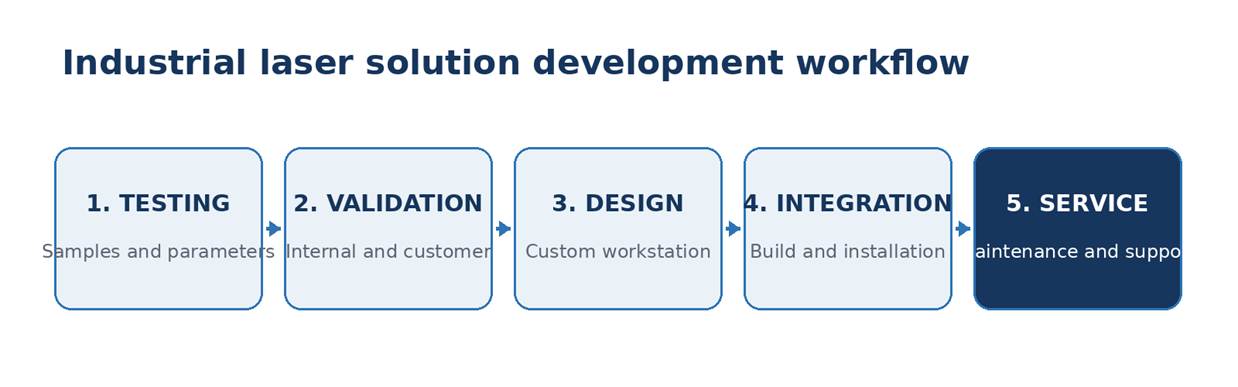
APEL Laser workflow for integrating a Coherent industrial laser solution: testing, validation, design, integration, and service
1. Application testing
We receive representative samples and define the material, geometry, cycle time, production volume, integration constraints, and acceptance criteria. We test sources and configurations that can create a stable process window, rather than a one-off successful result.
2. Result validation
Samples are assessed internally and then submitted to the customer. Validation may include dimensional measurements, visual inspection, marking contrast, surface quality, functional testing, or compatibility with downstream operations.
3. Workstation design
Once the process is confirmed, we define the optical configuration, motion system, part handling, automation, safety concept, monitoring, and software interface. The prototype is designed around the agreed acceptance criteria.
4. Integration and commissioning
APEL Laser manufactures and integrates the workstation and performs installation, commissioning, and operator training. The system is checked against the requirements established during validation.
5. Long-term service and support
After delivery, we provide preventive maintenance and after-sales support through our technical team. Further information is available on the APEL Laser services page.
Experience with demanding industrial applications
Industrial projects developed for customers are typically covered by confidentiality agreements. We can, however, describe the types of technical problems we address.
For one manufacturing application, we developed a fiber-laser-based marking process. The work covered the selection of the laser and optical configuration, parameter development, and integration of the process into a dedicated workstation concept.
In a microdrilling project, feature size, hole quality, repeatability, and material response had to be optimized together. Applications like these show why source power alone is insufficient: focusing, pulse characteristics, motion control, and processing strategy collectively determine the result.
A laser technology partner for machine builders and purchasing teams
Machine builders may have strong mechanical and automation capabilities but still require a specialist partner for source selection, parameter development, optics, safety, and validation. APEL Laser can take responsibility for this segment and deliver either a subsystem or a complete workstation ready for integration into a larger production platform.
For purchasing teams, this approach reduces the risk of acquiring a source that appears suitable on paper but does not fit the real process. Total cost is influenced by cycle time, repeatability, maintenance, commissioning effort, and support availability—not only by the laser purchase price.
Frequently asked questions
How do we choose between a fiber laser and a CO₂ laser?
Selection starts with material absorption and the required processing mechanism, followed by quality, speed, geometry, and integration requirements. Sample testing is the safest way to confirm the choice.
Can the laser be integrated into an existing production line?
Yes. We assess the available space, part handling, automation interfaces, cycle time, and safety requirements before defining the architecture.
What information is needed for initial testing?
Representative samples, part drawings, exact material information, acceptance criteria, volume, target cycle time, and any constraints of the existing process are useful.
Does APEL Laser provide support after installation?
Yes. The package can include installation, commissioning, training, preventive maintenance, and after-sales technical support.
Discuss your application with APEL Laser
If you are evaluating cutting, marking, drilling, ablation, cleaning, or micromachining, we can begin with a discussion about the material, geometry, validation criteria, and target cycle time.
Contact APEL Laser to schedule a technical discussion and define the next steps for application testing.

