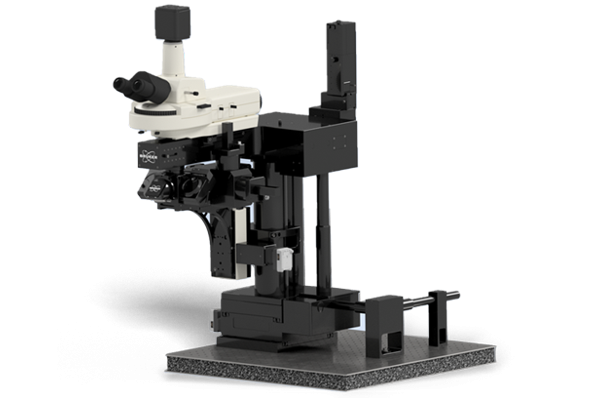

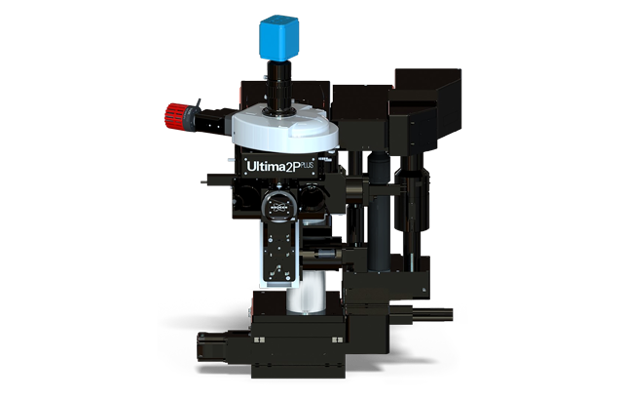
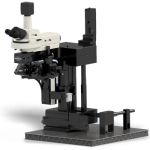
Bruker Ultima 2Plus Multiphoton Microscope
(I) Description
The Bruker Ultima 2Pplus is a high-performance multiphoton imaging platform designed for advanced in vivo and intravital imaging, combining deep-tissue imaging, a large field of view, high sensitivity, and fast acquisition. Its flexible optical architecture enables simultaneous multiphoton imaging, photostimulation, and electrophysiology, while an independent second scan path supports simultaneous imaging and photoactivation. Fully motorized objective positioning and rotation provide precise access to complex biological preparations, making the Ultima 2Pplus an ideal platform for neuroscience, optogenetics, functional imaging, and demanding intravital microscopy experiments.
(II) Features & Benefits
- Deep, high-sensitivity multiphoton imaging of living tissues
- Large field of view for imaging extended neuronal networks and biological structures
- Simultaneous imaging, photostimulation, and electrophysiology
- Independent second scan path for simultaneous imaging and photoactivation
- High-speed resonant scanning option for fast functional imaging
- Fully motorized objective positioning and rotation for flexible intravital imaging
- Support for two-photon and long-wavelength three-photon imaging
- Modular architecture for integration of optogenetics and advanced experimental accessories
- Integrated Prairie View software for acquisition, stimulation, synchronization, and experiment control
(III) Technical Specifications
- Imaging modality: Two-photon and multiphoton fluorescence microscopy
- Scanning method: Matched 6 mm Cambridge galvanometers with raster and spiral scanning
- Field of view: Approximately 1.375 × 1.375 mm with a 16× objective
- Raster scan speed: Approximately 1.65 fps at 512 × 512 pixels and >12 fps at 64 × 64 pixels
- Spiral scan speed: Approximately 6 fps at 512 × 512 pixels and ~30 fps at 64 × 64 pixels
- High-speed imaging option: 8 kHz resonant galvanometer; approximately 30 fps at 512 × 512 pixels and >1300 fps with reduced frame size
- Scan customization: User-defined line scans, point scanning, up to 120× scan zoom, and 360° scan rotation
- Photostimulation / uncaging: Independent second galvanometer scan path for precise visible or multiphoton photomanipulation
- Three-photon imaging: Long-wavelength imaging capability up to 1700 nm, depending on laser configuration
- Motorized X–Y stage: Approximately 15 cm × 7.5 cm travel
- Motorized Z-focus: 30 mm travel range
- Objective Z-piezo: Up to 1000 µm travel with 0.05 µm step size
- Objective positioning: Motorized orbital nosepiece with objective angle and rotation control
- Electrophysiology integration: Analog signal inputs and outputs for synchronization with electrophysiological recordings and external stimulation devices
- Photoactivation control: User-defined points and regions with synchronized laser modulation
- Software: Bruker Prairie View for imaging, Z-series, time-series, stage mosaics, ROI acquisition, photostimulation, and synchronization of external devices
- System architecture: Modular open platform designed for integration of electrophysiology, optogenetics, photostimulation, and custom experimental components
(IV) Manufacturer
Bruker
(V) Applications
In Vivo Brain Imaging, Intravital Microscopy, Neuroscience, Functional Calcium Imaging, Voltage Imaging, Optogenetics, Two-Photon Imaging, Three-Photon Imaging, Deep-Tissue Imaging, Neurovascular Imaging, Neural Circuit Mapping, Electrophysiology, Photostimulation, Photoactivation, Neurotransmitter Uncaging, Functional Brain Mapping, Large-Field-of-View Imaging, Fast Volumetric Imaging, Immunology, Cancer Biology.
Related products