
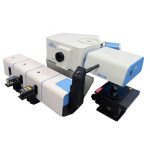
Kymera 193i Spectrograph | Andor
The Andor Kymera 193i is a compact, modular and user-friendly research-grade spectrograph designed for high-sensitivity spectral measurements. It combines a 193 mm focal length with an F/3.6 aperture, providing an effective balance between spectral resolution, recorded spectral range and photon collection efficiency.
Kymera 193i can be used for routine spectral acquisition as well as demanding applications including Raman spectroscopy, photoluminescence, microfluorescence, absorption and transmission measurements. When combined with Andor CCD, EMCCD, ICCD, sCMOS or InGaAs detectors, the system can be configured for measurements from the ultraviolet through the NIR and SWIR ranges.
Resources:
Key benefits of the Andor Kymera 193i
Automated Adaptive Focus
The patented Adaptive Focus technology automatically adjusts the spectrograph focus for the selected spectral configuration. This enables the instrument to optimise spectral resolution when the wavelength, diffraction grating, detector or experimental configuration is changed.
Motorised control reduces the need for manual adjustments and supports highly repeatable measurements.
High photon collection efficiency
The F/3.6 aperture enables efficient collection of weak optical signals. Kymera 193i is suitable for photon-limited applications including:
- Raman spectroscopy;
- micro-Raman;
- photoluminescence;
- microfluorescence;
- materials characterisation;
- biological sample analysis;
- NIR and SWIR spectroscopy.
Dual-grating turret
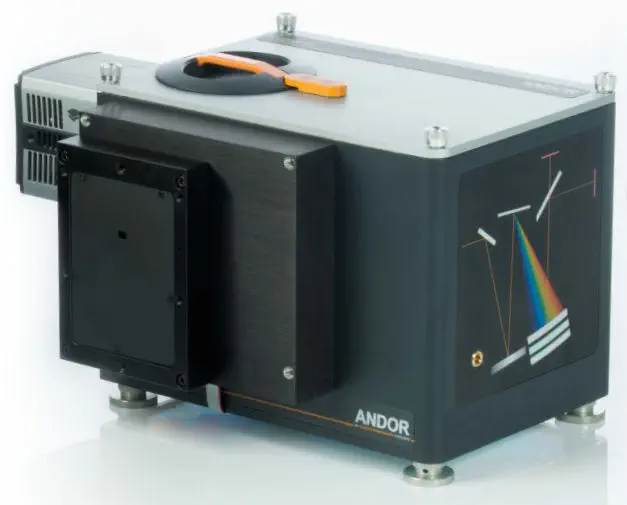
Kymera 193i incorporates an indexed turret holding two diffraction gratings. Gratings can be selected according to the required spectral resolution and wavelength range.
eXpressID™ technology uses RFID identification to recognise the installed gratings automatically and load the corresponding parameters into the software. The turret can be exchanged in the field, allowing the instrument to be adapted to new experiments.
Dual detector outputs
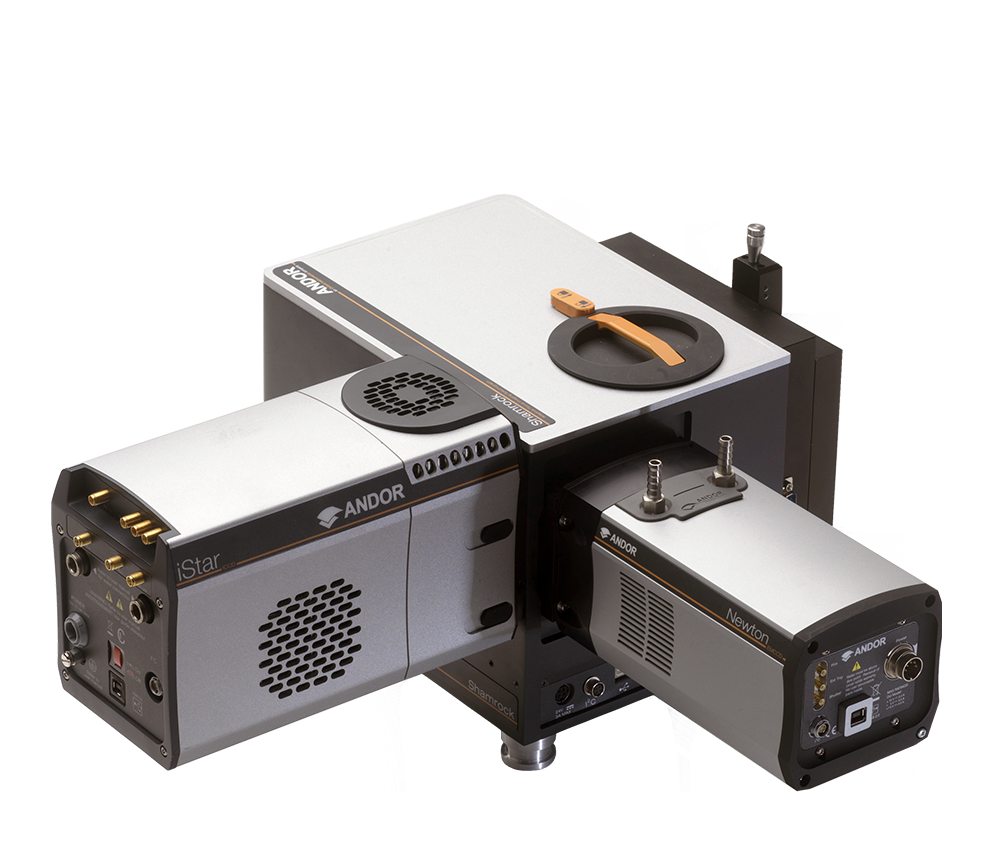
Dual-output configurations allow two detectors to be connected or an additional exit slit to be used.
A system may, for example, combine:
- a CCD detector for UV-VIS measurements;
- an InGaAs detector for NIR or SWIR;
- an ultra-sensitive EMCCD for very weak signals;
- an intensified ICCD camera for time-resolved measurements.
This architecture extends the accessible wavelength range and reduces the need to reconfigure the experimental setup.
Applications
Raman spectroscopy
Kymera 193i provides the combination of spectral resolution, optical throughput and flexibility required for Raman and micro-Raman measurements.
The instrument can be configured for:
- chemical composition identification;
- materials analysis;
- semiconductor characterisation;
- polymer analysis;
- biological sample analysis;
- Raman mapping;
- chemical reaction monitoring.
Photoluminescence and luminescence
The F/3.6 aperture and compatibility with deep-cooled Andor detectors make the system suitable for detecting weak optical emission.
Applications include:
- semiconductor photoluminescence;
- optoelectronic materials characterisation;
- emission from two-dimensional materials;
- quantum-dot analysis;
- phosphor characterisation;
- fluorescence and microfluorescence;
- recombination and defect studies.
Absorption, transmission and reflectance
Kymera 193i can be incorporated into systems for spectral absorption, transmission and reflectance measurements on solid, liquid or thin-film samples.
Microspectroscopy and chemical mapping
The system can be coupled to microscopes using direct coupling, optical relays, optical fibres or modular cage-system interfaces.
Its astigmatism-corrected optical design uses toroidal optics to improve sample-image relay and multi-track or multi-fibre detection. This makes the system suitable for microspectroscopy and XY or XYZ spectral mapping.
Materials science, chemistry and life science
Kymera 193i can be used in:
- materials physics and chemistry;
- nanotechnology;
- catalysis;
- electrochemistry;
- semiconductor research;
- biophysics;
- biomedical research;
- tissue and biomolecule analysis;
- OEM instrument development.
Main features
- 193 mm focal length;
- F/3.6 aperture;
- patented Adaptive Focus technology;
- motorised dual-grating turret;
- eXpressID™ RFID grating identification;
- two configurable detector outputs;
- astigmatism-corrected optical design;
- USB 2.0 interface;
- UV, visible, NIR and SWIR configurations;
- compatibility with CCD, EMCCD, ICCD, sCMOS and InGaAs detectors;
- protected-silver optical coating option for NIR and SWIR;
- purge option for measurements down to approximately 180 nm;
- monochromator configurations;
- microscope and mapping-system integration;
- compact and rugged design for laboratory or OEM integration.
Kymera 193i technical specifications
| Parameter | Specification |
|---|---|
| Instrument type | Imaging Czerny–Turner spectrograph |
| Focal length | 193 mm |
| Aperture | F/3.6 |
| Focusing | Motorised Adaptive Focus |
| Grating turret | Two interchangeable RFID-tagged gratings |
| Communication | USB 2.0 |
| Centre wavelength accuracy | 0.15 nm |
| Wavelength repeatability | 75 pm |
| Vertical magnification at detector centre | 1.07 |
| Outputs | One or two outputs, depending on configuration |
| Standard optical coating | Aluminium with MgF₂ |
| Optional optical coating | Protected silver for NIR/SWIR efficiency |
| Spectral range | Dependent on grating, detector and optical coating |
| Software | Andor Solis or SDK |
| Microscope integration | Direct coupling, optical relay, fibre or cage system |
Spectral performance depends on the diffraction grating, slit width, wavelength and selected detector. With a Newton DU940 detector, Andor specifies a resolution of approximately 0.21 nm using a 1,200 lines/mm grating at 500 nm and approximately 0.10 nm using a 2,400 lines/mm grating at 300 nm.
System configuration
Kymera 193i can be configured according to the requirements of the experiment.
1. Chassis configuration
Available options include:
- side input;
- direct camera output;
- additional side output;
- motorised output-port selection;
- manual or motorised slit;
- shutter for background acquisition and detector protection.
2. Diffraction gratings
The groove density, blaze wavelength and coating are selected according to:
- required wavelength range;
- required spectral resolution;
- spectral bandpass to be recorded simultaneously;
- detector format;
- required efficiency at the wavelength of interest.
3. Detector
The spectrograph can be combined with several Andor camera families:
- CCD for general spectroscopy and low-light signals;
- EMCCD for very high sensitivity and rapid mapping;
- ICCD for gated and time-resolved spectroscopy;
- sCMOS for high speed and large detection area;
- InGaAs for NIR and SWIR.
4. Optical signal coupling
Depending on the application, the system can use:
- optical fibres;
- XY-adjustable fibre couplers;
- C-mount adapters;
- direct microscope coupling;
- optical relays;
- modular cage systems;
- sample chambers;
- filter wheels.
Software and control
Andor Solis
Solis provides simultaneous control of the spectrograph, camera and motorised accessories, together with spectral acquisition, display and processing.
The software can automatically detect the Kymera spectrograph and compatible connected accessories.
SDK for custom integration
SDK options are available for experiment automation and integration of Kymera 193i into custom or OEM instruments.
They can be used to develop applications for:
- wavelength control;
- grating selection;
- slit adjustment;
- detector control;
- experiment synchronisation;
- automated acquisition;
- mapping-system integration.
μ-Manager and EPICS integration
Kymera 193i can be integrated with μ-Manager for microscopy and microspectroscopy control. Integration options are also available for EPICS-based infrastructure used in large or complex research facilities.
Why choose Kymera 193i?
Kymera 193i is suitable for laboratories requiring a flexible instrument without compromising sensitivity or repeatability.
Its principal benefits include:
- effective balance between resolution and light collection;
- automatic focus optimisation;
- simple exchange of diffraction gratings;
- capability to use two detectors;
- compatibility with a broad range of Andor cameras;
- straightforward microscope integration;
- field-upgradeable configuration;
- plug-and-play USB connectivity;
- compact design for space-constrained laboratories;
- suitability for OEM system integration.
Configuration and support from APEL Laser
APEL Laser can assist in defining a Kymera 193i configuration for your application, including:
- defining the required wavelength range;
- estimating the necessary resolution;
- selecting diffraction gratings;
- selecting the detector;
- defining slits and accessories;
- microscope or fibre coupling;
- integrating excitation sources;
- software configuration;
- installation and user training;
- technical support and service.
To receive a recommended configuration, send us the excitation wavelength, required spectral range, target resolution, sample type and estimated signal level.
Frequently asked questions
Is Kymera 193i a spectrometer or a spectrograph?
Kymera 193i is a spectrograph. It spectrally separates light and projects the spectrum onto an array detector. A complete configuration comprising the spectrograph, detector and software operates as a spectrometry system.
Can it be used for Raman spectroscopy?
Yes. Its 193 mm focal length, Adaptive Focus technology and availability of high-groove-density gratings make Kymera 193i suitable for a wide range of Raman and micro-Raman applications.
Can it measure in the NIR or SWIR?
Yes. For NIR and SWIR measurements, it can be configured with InGaAs detectors, protected-silver optics and diffraction gratings optimised for infrared wavelengths.
Can it be connected to a microscope?
Yes. Direct microscope coupling, optical relays, optical-fibre coupling and modular cage-system configurations are available.
Can it use two detectors?
Yes. Dual-output models can use two different cameras, such as a CCD for UV-VIS and an InGaAs detector for NIR-SWIR.
What spectral resolution can it achieve?
Resolution depends on the diffraction grating, detector, slit width and wavelength. High-groove-density configurations can achieve approximately 0.10 nm under the conditions specified by the manufacturer.
| Manufacturer | Andor |
|---|---|
| Applications / Industries | Chemistry, Luminescence, Nanotechnology, Raman, Spectroscopy |
| Type of interferometer | UV-NIR |
| Wavelength range | 0.15 nm |
Related products