




Welding Wire | Improbond
Improbond Laser Welding Wire and Filler Rods
Precision filler materials for mould, tool and metal component repair
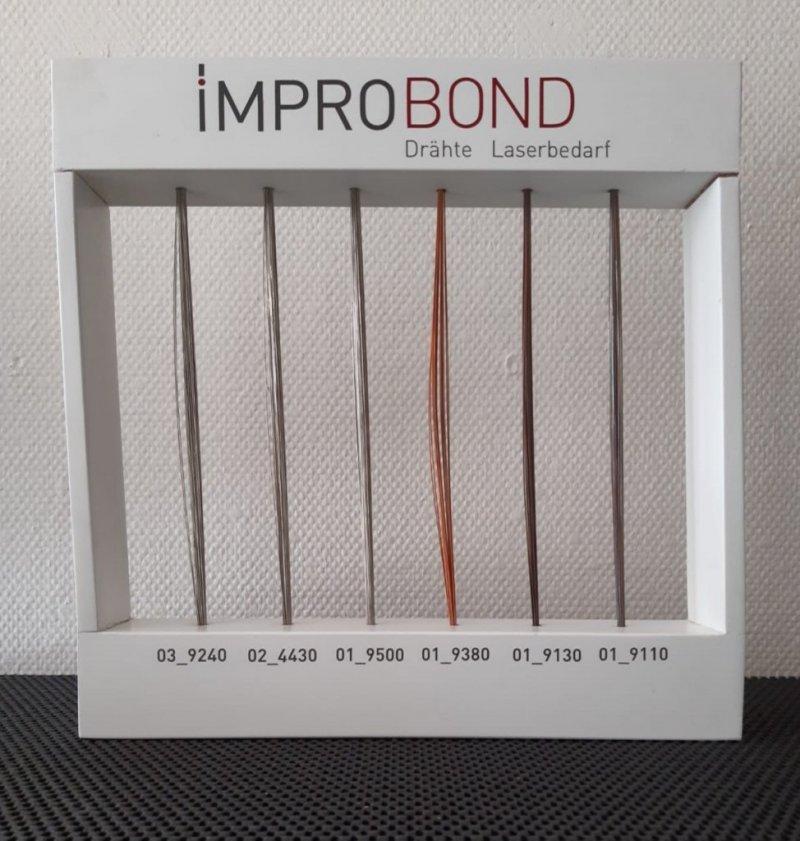
Improbond supplies a broad range of filler wires and straight rods developed for precision laser welding. The portfolio supports the repair, modification, joining and surface build-up of tool steels, stainless steels, nickel alloys, copper, aluminium, titanium and other specialist materials.
The products are supplied as either straight filler rods or wire on spools. They are intended for applications in which alloy selection, material traceability and reliable availability are critical.
Improbond was founded in 2012 and specialises in the rapid supply of an extensive range of high-quality laser welding filler materials.
APEL Laser can assist with selecting a filler wire based on the parent material, required hardness, subsequent surface treatment and the diameter supported by your laser welding system.
Request an alloy recommendation at sales@apellaser.ro
Why filler-wire selection matters
The selected filler material directly influences:
- metallurgical compatibility;
- susceptibility to cracking;
- hardness of the weld deposit;
- wear resistance;
- corrosion resistance;
- high-temperature performance;
- machinability;
- polishability;
- response to nitriding or heat treatment;
- colour and appearance of the repaired region.
The trade name of the parent steel alone may not provide sufficient information. Selection should also consider its chemical composition, heat-treatment condition, hardness, repair geometry and final operating requirements.
For unidentified or legacy components, material identification using documentation, positive material identification, spectroscopy or preliminary welding trials may be required.
Benefits of laser welding with filler wire
Laser welding provides accurately localised energy input, including on fine structures and component edges. Compared with welding processes producing a larger heat-affected zone, it can reduce distortion and minimise the amount of post-weld machining.
Potential benefits include:
- precisely localised heat input;
- limited workpiece distortion;
- repair of fine edges and details;
- narrow and flat weld beads;
- high mechanical strength;
- low oxidation with appropriate shielding;
- non-contact processing;
- good process repeatability;
- controlled deposition volume;
- reduced finishing requirements;
- repair of high-value components.
The controllability of laser energy and interaction time also supports the processing of materials with high melting points or high thermal conductivity.
Available material groups
Tool and mould welding wire
This category includes filler materials for repairing and modifying moulds, dies, punches, press tools, cutting tools and wear components.
Applications include:
- edge repair;
- contour modification;
- filling cracks and cavities;
- changing mould geometry;
- repairing worn regions;
- surface build-up;
- reconstruction of incorrectly machined features;
- adapting a mould to a revised component design.
The portfolio covers materials used extensively within the mould and tool industry, including grades such as 1.2311, 1.2312, 1.2343, 1.2344, 1.2367, 1.2714, 1.2738 and 1.2767, as well as variants associated with commercial grades such as P20 and H13.
Depending on the alloy, the weld deposit may be polished, textured, eroded, etched, chrome plated, nitrided, heat treated or subsequently coated. The suitability of each treatment should be confirmed for the selected filler material.
Stainless-steel and chromium-nickel alloys
Improbond supplies filler materials for laser welding martensitic, austenitic and other chromium-nickel steels.
Catalogue examples include materials corresponding to grades such as:
- 1.4009;
- 1.4115;
- 1.4122;
- 1.4316;
- 1.4332;
- 1.4337;
- 1.4430;
- 1.4455;
- 1.4551;
- 1.4576;
- 1.4937;
- 316L;
- 420;
- Stavax-type alloys.
Depending on composition, these wires can be selected for:
- corrosion resistance;
- low-temperature toughness;
- elevated-temperature performance;
- dissimilar-material joining;
- plastic mould repair;
- food or chemical equipment;
- medical components;
- polished surfaces.
Improbond’s catalogue includes low-carbon wires for austenitic Cr-Ni-Mo steels and martensitic alloys with stated wear resistance at temperatures up to approximately 450°C.
Nickel-based alloys
Nickel-based filler wires can be selected for:
- high-temperature alloys;
- corrosion-resistant components;
- dissimilar-material joints;
- tough or elastic deposits;
- high-strength steels;
- cast iron;
- nickel-to-steel joints;
- cryogenic applications.
Catalogue examples include materials such as 2.4831 and 2.4806. Depending on the precise alloy, Improbond lists properties including oxidation resistance at temperatures up to approximately 1,000°C and toughness at very low temperatures.
Actual service limits depend on the alloy, parent material, welding procedure and final component design.
Copper and copper-alloy filler wire
Materials are available for applications involving:
- pure copper;
- Ampcoloy alloys;
- aluminium bronzes;
- copper-to-steel joining;
- electrical-discharge-machining electrodes;
- press tools;
- surfaces requiring electrical or thermal conductivity.
One catalogue example, material 2.1211, is intended for welding copper and Ampcoloy alloys and for repairing spark-erosion electrodes. Improbond describes the deposit as ductile, fine-grained and electrically conductive.
When welding copper, process development must account for high thermal conductivity and reflectivity at the laser wavelength.
Aluminium-alloy filler wire
The portfolio includes materials for Al-Si, Al-Mg-Si and Al-Mg alloys, including:
- 3.2245 for Al-Si alloys containing up to approximately 7% silicon;
- 3.2384, an AlSi7Mg0.6 material;
- 3.2585 for Al-Si alloys containing up to approximately 12% silicon;
- 3.3535, an AlMg3 material;
- additional wires for Al-Mg groups and heat-treatable aluminium alloys.
Material 3.3535 is specifically described as suitable for applications in which the component will subsequently be anodised.
Weldability and hot-cracking susceptibility should be evaluated against the precise parent alloy. Representative sample trials are advisable for difficult combinations.
Titanium and specialist alloys
Improbond lists filler materials for:
- titanium Grade 1;
- titanium Grade 2;
- titanium Grade 5;
- cobalt-chromium alloys;
- other specialist materials.
For titanium, Improbond emphasises complete inert-gas coverage of the weld and the quality of the shielding gas. The catalogue specifies argon 5.0 for the listed titanium materials.
Cobalt-chromium alloys may be relevant to dental and medical applications, subject to the required process validation and regulatory controls.
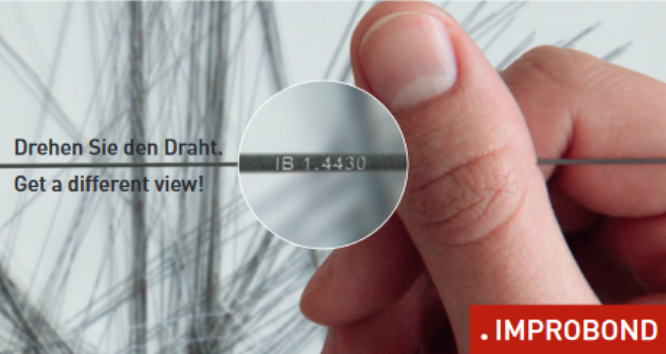
Marked wire for improved process safety
An important differentiator of the Improbond range is the availability of wire engraved with the material number.
Permanent material identification can support:
- reduced risk of alloy mix-ups;
- identification at the workstation;
- improved process safety;
- material and batch traceability;
- controlled production workflows;
- documentation of repair procedures.
Improbond states that its marked products support regulated applications and UDI identification requirements according to IMDRF principles for medical products. Applicability should be confirmed for the exact material, process and regulatory context.
Supply forms and diameters
Improbond filler materials are available as:
- straight rods;
- wire on spools.
The general catalogue lists rod diameters of:
- 0.2 mm;
- 0.3 mm;
- 0.4 mm;
- 0.5 mm;
- 0.6 mm;
- 0.7 mm;
- 0.8 mm.
Straight rods are listed in 100 g packaging units. Spool formats include K80, K125, K160, MA125 and SH253, with quantities available from 100 g.
The availability of each alloy in a particular diameter or packaging format should be confirmed when ordering.
Straight rods or spooled wire?
Straight filler rods
Straight rods are commonly used for:
- manual laser welding;
- mould repair;
- localised deposition;
- low material volumes;
- rapid alloy changeover;
- complex repair geometries.
The operator manually introduces the filler rod into the melt pool and directly controls its position and deposited volume.
Spooled filler wire
Spooled wire is suitable for:
- automated feeding;
- robotic systems;
- repetitive processes;
- longer weld seams;
- production applications;
- automatic wire feeders;
- automated cladding and deposition.
Spool selection should consider feeder compatibility, wire diameter and the minimum permitted bending radius.
Applications
Plastic injection mould repair
Laser welding can be used for:
- damaged-edge restoration;
- filling worn areas;
- geometry correction;
- machining-error repair;
- cavity modification;
- shut-off repair;
- reconstruction of surfaces requiring polishing or texturing.
Filler selection should consider mould-steel grade, hardness, polishability, texturing and thermal response.
Press, stamping and cutting tools
For tools exposed to compression, impact and abrasion, materials may be selected for:
- high hardness;
- wear resistance;
- edge retention;
- elevated-temperature resistance;
- sufficient toughness to reduce cracking.
Automotive applications
Applications may include repair of:
- moulds and dies;
- injection components;
- precision mechanical components;
- sealing surfaces;
- prototype components;
- locally defective parts;
- aluminium and steel components.
Medical devices and dental technology
Marked materials and specialist alloys may be relevant to:
- medical instruments;
- stainless-steel components;
- titanium components;
- cobalt-chromium alloys;
- moulds for medical products;
- dental work.
The filler material and welding process must be qualified against the requirements applicable to the final product.
Industrial maintenance and repair
Laser welding can extend the service life of:
- shafts;
- bearing regions;
- edges;
- sealing seats;
- machine components;
- worn tools;
- parts with local cracks or defects;
- components that are difficult or expensive to replace.
Design changes and prototypes
Filler material can be used for:
- rapid geometry modification;
- local addition of material;
- prototype correction;
- tool adaptation;
- trialling revised configurations;
- correcting machining errors.
Improbond positions laser welding as a precise, rapid and low-distortion method for repairing or modifying components affected by damage, wear or design changes.
How to select a filler material
1. Identify the parent material
Useful information includes:
- material number;
- standard;
- commercial grade;
- chemical composition;
- material certificate;
- current hardness.
2. Define the welding objective
Material selection may differ for:
- crack repair;
- edge reconstruction;
- cavity filling;
- increasing wear resistance;
- joining;
- cladding;
- geometry correction;
- creating a polished finish.
3. Define the required properties
Consider:
- hardness;
- toughness;
- wear resistance;
- corrosion resistance;
- service temperature;
- conductivity;
- colour match;
- machinability;
- polishability.
4. Define subsequent operations
Confirm whether the repaired region will be:
- milled;
- ground;
- polished;
- etched;
- textured;
- EDM processed;
- nitrided;
- chrome plated;
- anodised;
- heat treated;
- PVD or CVD coated.
5. Define the welding system
The configuration should be matched to:
- laser source;
- wavelength;
- power or pulse energy;
- pulsed or continuous-wave operation;
- manual or automatic feeding;
- permitted wire diameter;
- spool format;
- shielding gas;
- nozzle geometry.
Process considerations
The exact welding parameters depend on alloy, diameter and system configuration. Important considerations include:
- surface cleaning;
- removal of oil and oxides;
- matching wire diameter to melt-pool dimensions;
- filler-wire angle;
- feeding speed;
- pulse energy;
- pulse duration and frequency;
- spot overlap;
- shielding-gas flow;
- preheating;
- interpass temperature;
- controlled cooling;
- post-weld heat treatment.
Some martensitic alloys may require preheating. Titanium requires effective inert-gas shielding. Aluminium requires an assessment of hot-cracking risk, while copper requires consideration of its high thermal conductivity.
Why choose Improbond laser welding wire?
Benefits of the Improbond portfolio include:
- an extensive selection of alloys;
- dedicated tool and mould materials;
- stainless-steel and chromium-nickel alloys;
- nickel-based alloys;
- copper alloys;
- aluminium alloys;
- titanium and specialist materials;
- straight-rod and spool supply;
- fine diameters for precision laser welding;
- engraved material-number options;
- reduced risk of material mix-ups;
- support for repair, joining and surface build-up;
- specialist consultation for alloy selection.
Selection and supply through APEL Laser
APEL Laser can support:
- identification of the appropriate alloy;
- parent-material equivalence;
- diameter selection;
- selection between rods and spools;
- wire-feeder compatibility checks;
- selection of polishable materials;
- selection for wear resistance;
- selection for temperature or corrosion resistance;
- supply of available technical documentation;
- process trials;
- parameter optimisation;
- laser-welding-system integration.
For an initial recommendation, provide:
- parent-material grade or material number;
- a photograph of the repair region;
- parent-material hardness;
- required final properties;
- subsequent finishing operations;
- wire diameter currently used;
- welding-system model;
- required quantity.
Request a filler-wire recommendation at sales@apellaser.ro
Frequently asked questions
Are these products wires, rods or electrodes?
The technically correct terms are laser welding filler wire and filler rod. In some markets, including Romania, the products may colloquially be described as laser welding electrodes, although they do not function as electrical electrodes.
What is the difference between filler wire and filler rod?
Wire is generally supplied on a spool and can be fed automatically. A straight rod is normally introduced manually and is widely used for mould and tool repair.
Which diameters are available?
The general catalogue lists straight rods from 0.2 to 0.8 mm in diameter. Availability depends on the selected alloy.
How do I identify the correct wire?
Start with the parent-material number, hardness, required properties and the treatments that will follow welding.
Is there a universal filler wire?
Some alloys are recommended for general repairs or situations in which the parent alloy is unknown. A universal wire is not, however, optimal for every material and application.
Can the weld be polished to a mirror finish?
Certain variants are recommended for surfaces requiring mirror polishing. Selection must be matched to the parent steel and the required finishing standard.
Can aluminium and copper be laser welded with filler wire?
Yes. Improbond supplies materials for aluminium, copper and associated alloys. The process must be adapted to the thermal, reflective and metallurgical behaviour of the metal.
Are titanium filler materials available?
Yes. The catalogue includes materials for titanium Grades 1, 2 and 5. Titanium welding requires careful inert-gas protection.
Why use marked wire?
An engraved material number reduces the risk of using the wrong alloy and supports traceability.
Are small quantities available?
The catalogue lists 100 g rod packages and certain spool formats available from 100 g. Minimum quantities should be confirmed for the requested alloy.
| Manufacturer | Improbond |
|---|---|
| Applications / Industries | Automotive industry, Seams and corner joints on casings, Welding, Welding of short tubes on smooth sheet metal, Welding seams on junctures |